 Now on Amazon
The AI Generation Parent Companion
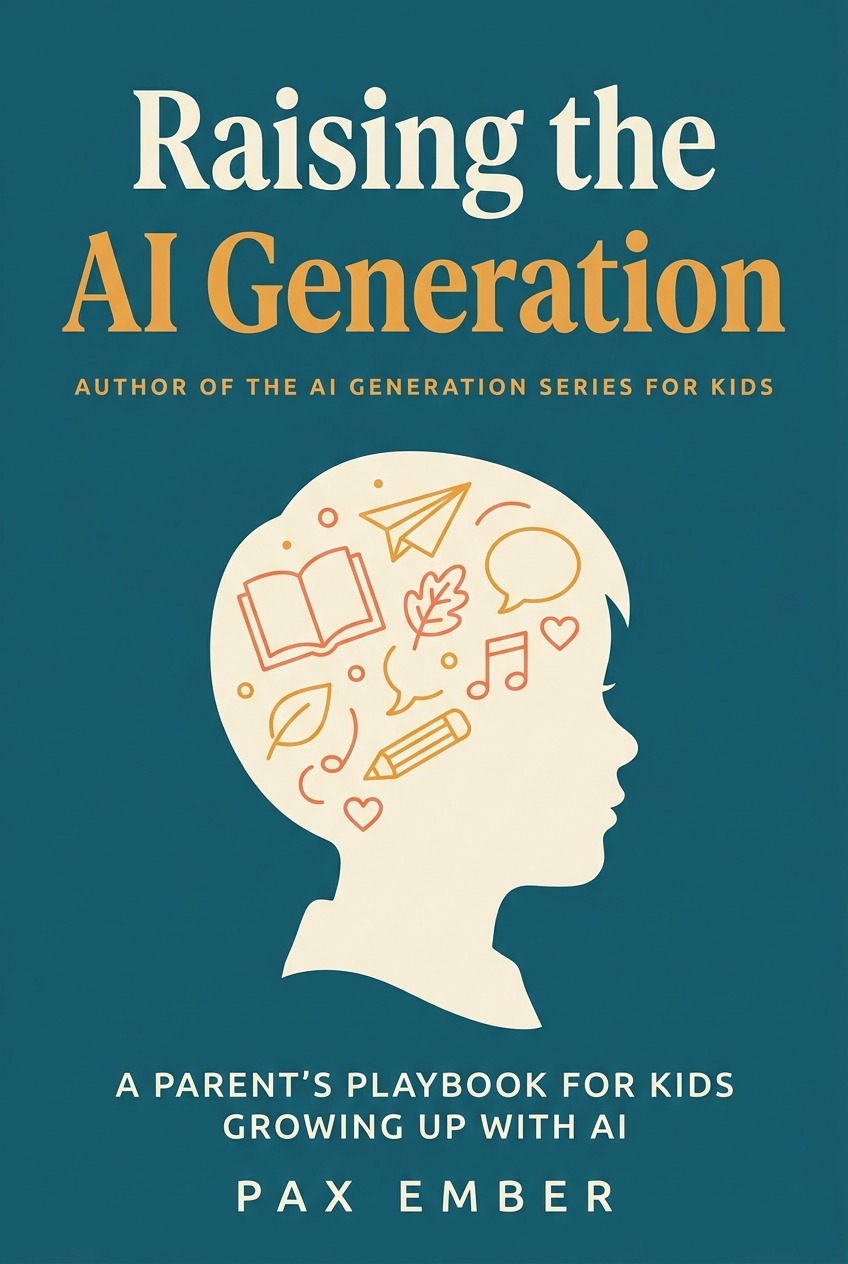
Raising the AI Generation
A parent’s playbook for kids growing up with AI. The dedicated parent companion to the Welcome to the AI Generation trilogy, picking up where the trilogy’s Parent Corners leave off and going deeper on the parenting side.
Your kid is growing up in a world shaped by AI. The trilogy gives them the literacy they need. This book gives you the parenting framework to match.
What to notice at what age. The conversations worth having early. The AI-specific worries that are real versus the ones that are overhyped. How to let your kid lead when they already know more than you, without losing the ground you’re supposed to hold.
No tech expertise required. Written the same way the trilogy is written. Honest, research-backed, usable on a Tuesday night.
What is inside
Your kid is already using AI. They ask chatbots the questions they used to bring to you,
turn in schoolwork a machine helped write, and meet AI companions that talk back. Most advice
comes in two flavors: AI is a monster, or AI is a miracle. Neither one helps you at the kitchen
table on a Tuesday night. This book is the calm middle.
What to say when your kid asks about AI
Not a script to memorize. The actual words that work, and the reason they work, so you can
say them in your own voice. Including what to do when the honest answer is that you do not know
yet, which is the answer more often than any parent expects.
How to handle AI in schoolwork
Where the line sits between a tool and a shortcut, how to tell which side of it your kid is
on, and how to talk about it without turning homework into a trial. Teachers are still working
this out too. You are not behind.
What to do about AI companions
Character apps and chatbot friends are built to be warm and always available, and children
form real attachments to them. This covers what is actually happening when that happens, which
parts are harmless, which parts are worth watching, and how to stay the person your kid still
brings things to.
Family AI rules that actually stick
Rules fail when they are handed down and never revisited. This is how to build a short set
of household agreements your kid helps write, that survive contact with a real week, and that
grow as your kid does.
Who this book is for
Parents of kids roughly ages 8 to 14 who want a plan instead of a panic. No technical
background is assumed and none is needed. If you have never opened a chatbot yourself, you can
still use every chapter in this book tonight.
It is also written for the parent whose kid already knows more than they do. That is a
common and uncomfortable place to stand, and it does not mean you have lost your footing. What
you know about your own child is the part no machine has.
How it fits with the kids’ books
The Welcome to the AI Generation trilogy is written for the kid: hands-on missions,
real tools, and the literacy to use AI well. This is the parent side of the same house. It
picks up where the trilogy’s Parent Corners leave off and goes further, so a family can
read in both directions at once.
You do not need the trilogy to use this book, and you do not need this book to use the
trilogy. Together they cover the same ground from both chairs.
Questions parents ask
How do I explain AI to a child?
Start with something the child already uses. A video feed that guesses what they want next
is AI, and so is the autocorrect that finishes their words. Once a child sees that AI is a
pattern machine rather than a mind, most of the scary version falls away and the useful
questions get easier to ask.
Is AI good or bad for kids?
Both, depending entirely on how it is used and how much a child understands about what it
is. The book separates the worries that hold up from the ones that do not, so your attention
goes where it earns something.
Should students use AI for homework?
Sometimes, with limits worth being specific about. Using AI to explain a concept your kid
is stuck on is closer to a tutor than to cheating. Having it produce the finished work is a
different thing. The book gives you language for that difference that a child can follow.
Are AI companions safe for kids?
They are built to feel like friends, and children respond to them as friends. That is
worth taking seriously without treating it as a crisis. The book covers what to watch for,
what is ordinary, and how to keep the conversation open instead of driving it underground.
Do I need to understand AI myself first?
No. Every chapter is written for a parent starting from zero. What the book asks of you is
attention, not expertise.
What age is this book for?
It is written for parents of kids about 8 to 14. The youngest sections work earlier than
that, and the sections on schoolwork and companions stay useful into the teen years.