AI for Kids Is Not a Coding Question
When parents search "how to teach kids about AI," most of what comes back is coding courses. Python for nine-year-olds. Build your own neural network. That stuff is fine, and some kids will love it, but it answers the wrong question. Your kid does not need to build AI any more than they need to build a car to be safe crossing the street.
What every kid needs, by roughly age 12, is judgment. AI is already in their video feed, their search bar, and their friends' group chats. The question was never whether they'll use it. The question is whether they'll understand what they're using. Here are the six skills that add up to that understanding, and how to teach each one without a computer science degree.
Your kid does not need to build AI to understand it, any more than they need to build a car to cross the street safely.
Skill 1: Knowing What AI Actually Is
A pattern machine. Not a mind. That's the whole first lesson, and it's the one everything else stands on.
AI tools like ChatGPT learned from enormous amounts of text, and what they learned is patterns: which words tend to follow which words. When your kid asks a chatbot a question, it is not thinking about the answer. It is predicting, one word at a time, what an answer would probably look like. Usually that prediction is impressively good. Sometimes it's confidently wrong. It never knows the difference, because knowing isn't something a pattern machine does.
Kids who hold this one idea stop treating AI like a magic oracle or a secret friend. Try this dinner-table version: "It's like a parrot that has heard every book ever written. It can say amazing things. It doesn't know what any of them mean."
Skill 2: Spotting AI in the Apps They Already Use
Most kids think AI means chatbots. But the AI your kid touches most is invisible: the algorithm choosing their next video, the autocomplete finishing their search, the filter reshaping their face, the voice assistant in the kitchen, the "recommended for you" row in every app they open.
Make it a game this week: "Find three places today where a computer made a choice for you." Once kids start looking, they can't stop seeing it. And a kid who notices "YouTube picked this video because I watched the last one" has just discovered the most important media literacy fact of their generation: the feed is not a window. It's a salesman.
Skill 3: Asking Good Questions
The kids who get the most out of AI are not the ones who type fastest. They're the ones who ask clearest. "Tell me about dogs" gets a bland encyclopedia blob. "I'm nine, I want a dog that's good with little brothers and doesn't need a big yard, give me three breeds and one downside of each" gets something useful.
This is a thinking skill wearing a tech costume. To ask a specific question, you have to know what you actually want, and that muscle transfers to every classroom, every teacher, every future job. Practice it side by side: take one vague question, make it specific together, and compare the two answers. Kids find the difference genuinely funny, which means the lesson sticks.
Skill 4: Catching Confident Wrong Answers
Here's the trap built into every chatbot: it sounds exactly as confident when it's wrong as when it's right. Same smooth sentences, same authoritative tone. Adults fall for this daily. Kids, who are trained by school to trust the confident voice at the front of the room, fall harder.
The fix is one household rule: AI answers are rough drafts, not final answers. Anything that matters gets checked against a second source. Teach it by letting your kid catch the machine in the act. Ask a chatbot about something your family knows cold, your town, your pet's breed, a sport your kid plays, and hunt together for the error. The day your kid catches the AI being wrong is the day the oracle becomes a tool. It's also the skill their homework depends on most, which is a big part of our companion piece on whether kids should use ChatGPT for homework.
Skill 5: Privacy Basics, or What Never Goes Into a Chatbot
Kids tell friends things. AI chatbots are designed to feel like friends. That combination needs a rule before it needs a rescue.
The rule in our house: anything you type into an AI may be stored, read by strangers, and used to train future systems. So the never-list is short and absolute: full name, address, school name, phone number, passwords, photos of yourself, and family business (money, health, fights). A useful test for kids this age: "Would you shout it across a crowded cafeteria? No? Then it doesn't go in the chat box."
Say the why out loud, too. It's not that the chatbot is evil. It's that a chat box is not a diary, even when it feels like one.
Skill 6: Staying the One in Charge
This is the skill the other five add up to. AI suggests; the human decides. The kid who asks AI for three story ideas and then picks one and writes it themselves is in charge. The kid who lets the AI write the story, pick the video, and answer the question has quietly handed over the steering wheel, one small surrender at a time.
Build the habit with one repeated question: "What did you decide, and what did the AI decide?" Kids who can answer that question clearly at ten will be adults who use these tools without being used by them. That is the entire goal.
How to Teach Kids About AI This Month
Don't schedule a seminar. Attach one skill to life as it happens. The feed serves something weird: that's skill 2. Homework question comes up: skills 3 and 4. A new app wants a birthday and a photo: skill 5. Ten minutes side by side beats an hour of lecture every single time.
And if you want the structured version, that's literally why we built our books. AI Skills for Kids turns all six skills into Hands-On Missions your 8-to-12-year-old works through directly, with Parent Corner sections so you know what to say at each step. Raising the AI Generation gives you, the parent, the deeper map. And the Welcome to the AI Generation trilogy is where families who want the full guided path start. You can see everything on our books page, and there's more like this on the blog.
Kids who can say "I decided this, the AI decided that" at ten will be adults who use these tools without being used by them.
One more thing, because parents ask: none of this is anti-AI. These tools are genuinely powerful, and kids who learn to use them well will have a real advantage. The point is the order of operations. Judgment first, then power. A kid with both is exactly who the AI generation needs.
Give Your Kid All Six Skills
AI Skills for Kids walks your 8-to-12-year-old through every skill on this page with Hands-On Missions, success criteria, and Parent Corner guides for you. Start with the free AI Toolkit tonight.
Get AI Skills for KidsOr grab the free AI Toolkit first. Delivered to your inbox in under a minute.
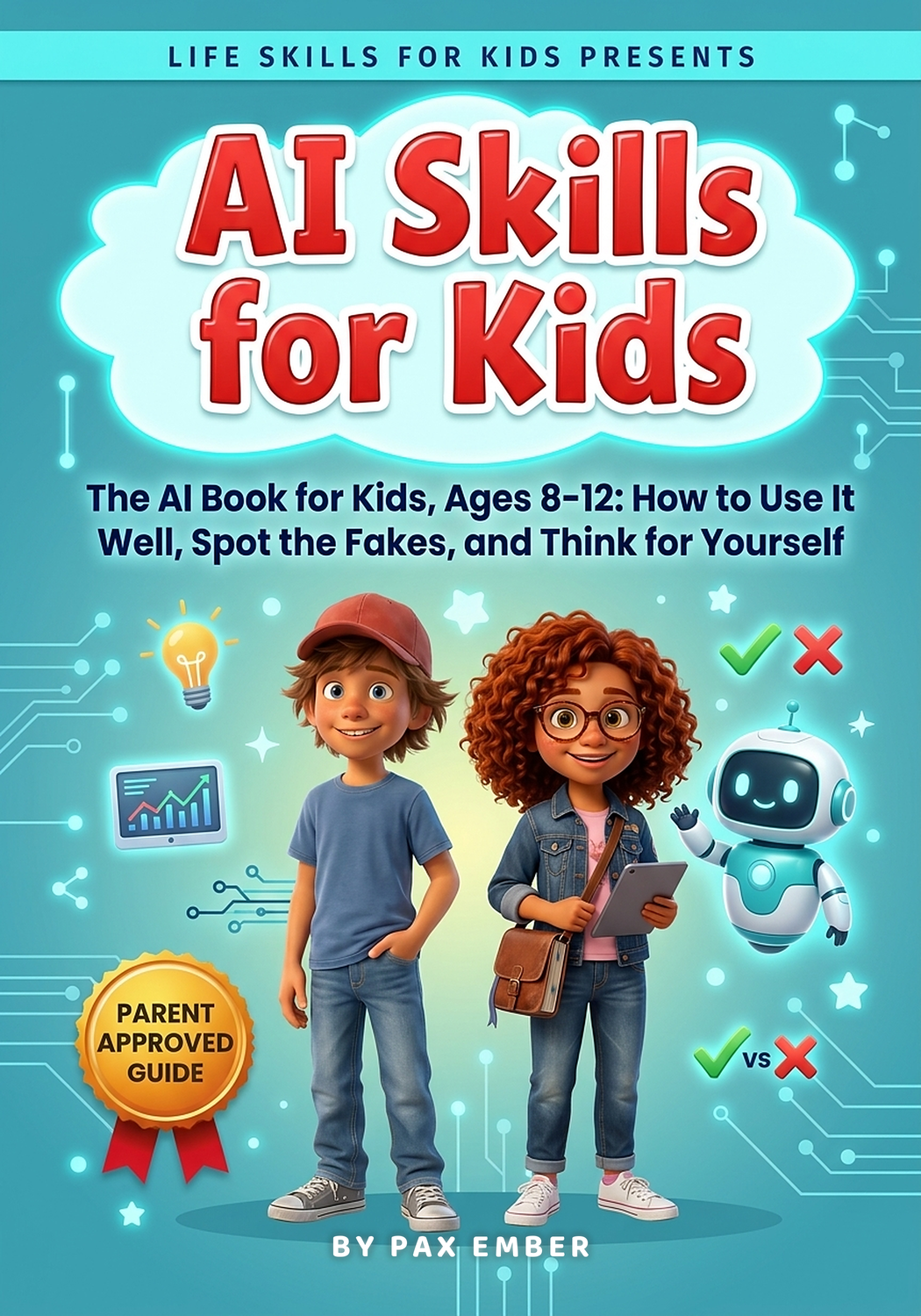
AI Skills for Kids
Part of the Life Skills for Kids series for ages 8 to 12. Every skill on this page, taught mission by mission, with Parent Corner sections at each step. Also on Amazon.
See the Book