The Question Behind "Should Kids Use ChatGPT?"
Somewhere in your house, probably this week, a kid stared at a worksheet and thought: the computer could just do this. They're right. It could. And that fact is not going away, which is why "should kids use ChatGPT for homework" has become one of the most-searched parenting questions on the internet.
Here's my honest answer after two years of writing about AI for families: yes and no are both the wrong place to start. The right place to start is a different question entirely.
Before you decide whether AI can touch the homework, ask what the homework is for.
A spelling list exists to get words into your kid's memory. A math worksheet exists to build fluency until the steps are automatic. An essay exists to teach a kid to organize thoughts into an argument. None of those assignments exist to produce a finished artifact. The worksheet itself goes in the recycling. The thing the assignment was actually building lives in your kid's head, or it doesn't.
Once you see homework that way, the ChatGPT question mostly answers itself. If the AI helps the thing get built in your kid's head, it's a learning tool. If the AI produces the artifact while your kid's head stays empty, it's a learning bypass. Same app. Opposite outcomes.
AI for Learning vs. AI Instead of Learning
The line is not about which tool your kid uses. It's about which brain does the work. Here's what each side actually looks like at the kitchen table.
AI for learning looks like this: your kid is stuck on long division, and instead of waiting until tomorrow to ask the teacher, they ask the AI to explain it a different way. Or they finish a draft and ask the AI to point out the two weakest sentences. Or they ask it to generate five practice problems like the one they got wrong, then work those problems themselves. In every one of those cases, the struggle stays where it belongs: in your kid.
AI instead of learning looks like this: "Write me a five-paragraph essay about the Louisiana Purchase." Thirty seconds later there's an essay. Your kid retypes it, changes a few words, and turns it in. The assignment is complete. The learning never happened. And the scary part is that from the outside, on grading day, both versions can look identical.
This is the exact distinction we teach kids directly in AI Skills for Kids, because a ten-year-old can absolutely understand it when it's put in their language. Which brings me to the analogy that has worked in every family I've shared it with.
The Robot at Soccer Practice
Imagine your kid plays soccer, and one Saturday they send a robot to practice in their place. The robot runs the drills perfectly. Every sprint, every touch, every shot. Coach is thrilled.
Now ask your kid: who got better at soccer?
The robot did. Obviously. Muscles grow on the body that does the reps. And your kid, standing on the sideline, got exactly nothing, even though "their" practice was completed flawlessly.
A robot that does your practice gets better at your sport. You don't.
Homework is practice for your brain. When ChatGPT writes the essay, the AI got the reps. Your kid's writing muscles sat on the bench. Kids get this instantly, because no eight-year-old on earth thinks sending a robot to soccer practice would make them a better player. The analogy does something a lecture never does: it moves the issue from "you're breaking a rule" to "you're robbing yourself," and that reframe changes who the rule belongs to.
What Age Should Kids Use ChatGPT?
The paperwork answer: OpenAI requires users to be 13, with parental permission until 18. That's the terms of service, and it's worth knowing.
The practical answer for the eight-to-twelve range is side-by-side use, on your account, with you in the room. Not because your kid is untrustworthy, but because these tools confidently make things up, and a kid who hasn't yet learned to catch that needs a co-pilot. Supervised use is also where the best conversations happen. When the AI says something wrong about volcanoes, and your kid catches it, that moment teaches more about how AI works than any rule you could post on the fridge. We wrote about building that judgment in the six AI skills every kid needs, and skill four, catching confident wrong answers, is the one homework depends on most.
Solo use is a trust milestone, like walking to school alone. It arrives at different ages for different kids, and it arrives after they've shown you, repeatedly, that they know which side of the learning line they're on.
The Family Conversation Script
Have this conversation before there's a problem, not after. Here's a script you can adapt tonight. It takes about ten minutes.
The Five-Step Homework Talk
1. Start with their world, not your worry. "Do kids in your class use ChatGPT for schoolwork? What do they use it for?" Then listen. You'll learn more in two minutes of listening than in twenty minutes of explaining.
2. Tell the robot-at-soccer-practice story. Let them answer the "who got better?" question themselves. Don't rush to the moral. They'll get there.
3. Draw the line together. Ask: "So when would using AI on homework help you get smarter, and when would it just do your reps for you?" Write their answers down. A line they helped draw is a line they'll defend.
4. Make the green list official. In our house the green list is: explanations when stuck, checking finished work, and generating practice problems. The red list is: anything where the AI's words get turned in as yours.
5. Leave the door open. End with: "If you're ever not sure which side of the line something is on, ask me. You will never be in trouble for asking." That sentence is the whole ballgame.
When You Find the Too-Polished Essay
It will happen. You'll read a paragraph and know, in your gut, that your kid did not write "moreover, the economic ramifications were profound." Here's what to do, and what not to do.
Don't open with the accusation. AI detectors are unreliable, and your certainty, however justified, isn't proof. Open with curiosity instead: "This is really strong. Walk me through how you wrote it." A kid who wrote it can tell you. A kid who pasted it will go quiet fast, and usually, in my experience, will come clean without much pressure, because most kids know exactly which side of the line they crossed.
Then skip the shame and go back to soccer. "The robot went to practice for you. You turned in its reps. So the assignment isn't done, because the assignment was never the essay. It was you learning to write one." Have them redo it, and let them use AI on the green list while they do: brainstorming out loud, getting feedback on their own draft, asking for explanations. That's not a loophole. That's the actual skill you want them to graduate with.
Last, look at the why. Kids usually reach for the bypass when the work feels impossible, not when it feels easy. A pasted essay is often a flare that says "I'm lost in this class." Answer the flare, not just the foul.
The bigger picture, for us as parents, is that our kids will spend their working lives with these tools. The goal was never to keep AI away from them. The goal is a kid who uses AI and stays the one in charge of it. That's the whole reason we wrote Raising the AI Generation for parents and AI Skills for Kids for the kids themselves: same line, taught from both sides of the kitchen table. If you want to go deeper on the foundations first, the Welcome to the AI Generation trilogy walks families through it mission by mission, and the rest of our blog and book catalog pick up from there.
Start the Conversation This Week
AI Skills for Kids gives your 8-to-12-year-old the homework line, the practice habits, and the judgment to stay in charge of AI, with Hands-On Missions for them and Parent Corner guides for you. And the free AI Toolkit gets your family started tonight.
Get AI Skills for KidsOr grab the free AI Toolkit first. Delivered to your inbox in under a minute.
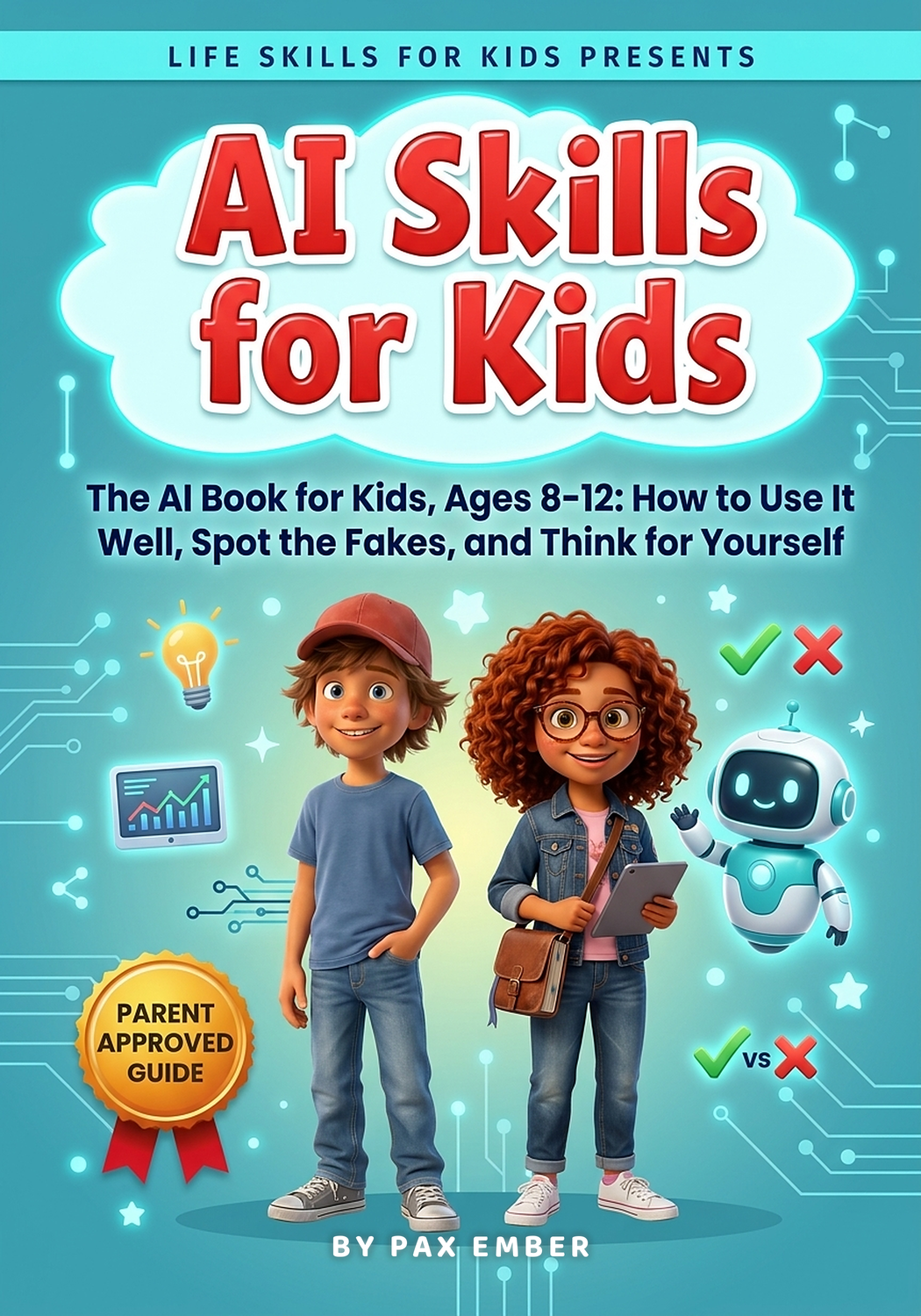
AI Skills for Kids
Part of the Life Skills for Kids series for ages 8 to 12. Hands-On Missions that build real AI judgment, plus Parent Corner sections so you're never guessing what to say. Also on Amazon.
See the Book