Cooking skills for teens are learned in order, not from recipes
Hand a teenager a recipe and they will follow it once. Hand them a skill and they can cook anything that uses it. That is the whole difference between teaching teens to cook and keeping them busy in the kitchen. A working kitchen teaches skills in a fixed order, because each one depends on the one before it: you cannot sauté until you can dice, and you cannot dice until you can hold the knife. This checklist is that order, taken from the 36-lesson ladder in the Culinary Arts Workbook for Teens. Use it to see where your teen actually is, and what comes next.
Rung zero: the safety contract
Before anything touches heat, the teen reads and signs a short contract with you. Six lines: wash hands with soap for 20 seconds before cooking and after touching raw meat, poultry, fish, or eggs; keep raw meat separate from ready-to-eat food, on its own board; cook meat, poultry, fish, and eggs to a safe internal temperature, checked with a thermometer; turn pot handles inward, keep a towel dry, and never leave a hot pan or a flame unattended; cut with a claw grip, a sharp knife, and full attention; clean as you go. Two signatures, two dates. Everything below sits on top of it.
The checklist, unit by unit
Unit 1: Kitchen foundations
Set up a clean station with every ingredient measured into its own bowl before any heat (mise en place). Read a recipe start to finish before touching anything. Name the core tools. Know the stovetop and the oven. Measure by weight and understand a ratio. The first recipe is a snack board, which needs a paring knife and no heat.
Unit 2: Knife skills
Pinch grip on the blade, the other hand curled into a claw with the blade resting against the knuckles. Hone the edge before cutting; a sharp knife is a safe knife because it bites where you aim it instead of skidding. Store it in a block or on a strip, never loose in a drawer. Then the cuts: make a flat side so the food does not roll, slice even planks, stack and cut into strips, cut across into an even dice, rock the knife over a pile for a mince. Even pieces cook at the same rate; that is why the cuts matter. Then onion, garlic, and herbs, then julienne and chiffonade.
Unit 3: Cooking methods
Boiling and simmering. Steaming. Sautéing: the pan is hot before the food goes in, the food sits in a single uncrowded layer, and it browns before it moves. Roasting and baking with dry heat. Braising, which combines a sear with slow, wet heat. A teen who can do these five can cook most of what a family eats.
Unit 4: Breakfast and eggs
Scrambled on low, stirred gently until just set; fried; boiled by the clock and cooled in ice water. Then an omelet and a frittata, then pancake and waffle batters. The first semester ends with a capstone: a plated breakfast, cooked and timed by the teen alone.
Units 5 and 6: Grains, pasta, legumes, vegetables, salads, soup
Rice and grains. Pasta with a simple sauce. Beans and lentils. A grain bowl built from the three. Vegetable cookery, salads and dressings, and a stock that becomes a soup.
Unit 7: Proteins
Poultry to 165°F. A whole cut like a pork chop or a steak seared hard and cooked to 145°F, then rested at least 3 minutes, because the temperature holds and the juices settle. Ground meat to 160°F, handled cold, with hands, board, and tools washed right after. Fish and seafood to 145°F. Plant protein. Every one checked with a thermometer, not a guess.
Units 8 and 9: Flavor and baking
Salt, acid, heat, and herbs, and how each one changes a dish. Simple sauces. Quick breads and muffins, cookies, biscuits, and a simple cake.
Unit 10: Putting it together
Pick a main and a side, write a timeline backward from serving time, start the longest item first, and use one dish's oven or resting time to finish the other. The course ends with a final meal, planned, cooked, timed, and plated by the teen.
What can a 14-year-old cook?
Parents ask this as an age question, and it is a rung question. A 14-year-old who has signed the contract and climbed the first two units can cook a snack board, a salsa, and a chopped salad with a real knife. Add the cooking methods and the egg unit and they can put a plated breakfast on the table. Add the protein unit and they can pan-sear pork chops and check them at 145°F. The ladder is the same at 12 and at 18; what changes is how fast they climb it. Every recipe in the workbook carries a one-to-three whisk rating: one whisk means no heat and no knife, two means heat or a knife, three means both plus timing. Start at one whisk and move up.
The temperatures a teen must know
These are from USDA Food Safety and Inspection Service guidance, and they are the part of cooking that is not a matter of taste. Use a food thermometer in the thickest part, not touching bone.
- Poultry, whole and ground: 165°F
- Ground beef, pork, veal, and lamb: 160°F
- Beef, pork, veal, and lamb steaks, chops, and roasts: 145°F, then rest 3 minutes
- Fish and seafood: 145°F
- Egg dishes: 160°F
- Leftovers and casseroles: 165°F
Bacteria grow fastest between 40°F and 140°F, so perishable food does not sit out more than 2 hours, or 1 hour if the room is above 90°F. The four steps a teen should be able to say back: clean, separate, cook, chill.
How to grade it
Each skill ends with a Cook-and-Sign check: the teen cooks it for real, a parent or teacher watches against a short checklist, and signs and dates it. Once a week on top of the lessons, the teen cooks one full meal for the household and logs it. That weekly meal is where a cook is actually made: feeding real people on a real night, 36 times across a year.
If you are homeschooling, the workbook is built to record as Culinary Arts I, a full-year, one-credit elective. The grade is 60 percent practical, from the 36 checks with the two capstones counting double, and 40 percent knowledge, from written quick checks scored against the answer key. Ninety and up is an A. The hours come to roughly 120 to 180 across the lessons, the weekly meal, and the planning, which is the range a one-credit course generally represents. The Safety Contract, the Cook-and-Sign Log, and the Safe Temperature Chart are free to print in the homeschool kit.
Questions parents ask
What cooking skills should a teen have?
In order: set up a station and read a recipe through, hold a knife with a pinch grip and a claw, slice, dice, and mince evenly, boil, steam, sauté, roast, and braise, cook eggs three ways, cook poultry to 165°F, whole cuts to 145°F with a rest, and ground meat to 160°F, build flavor with salt and acid, bake a quick bread, and plan a two-item meal so both finish together.
What can a 14-year-old cook?
With the safety contract signed and the first two units done, a 14-year-old can cook a plated breakfast, a pasta with a simple sauce, a grain bowl, roasted vegetables, and pan-seared pork chops checked with a thermometer. The limit is not age; it is which rungs of the ladder they have climbed.
How do I teach a teen to cook without doing it for them?
Watch instead of helping. Each lesson ends with a Cook-and-Sign check: the teen cooks the skill for real while you watch against a short checklist, then you sign and date it. If the skill is not there yet, they cook it again next week. Your hands stay out of the pan.
Does a home cooking course count for high school credit?
Yes, if it is built to. The Culinary Arts Workbook records as Culinary Arts I, a full-year, one-credit elective, with a transcript-ready description, a grade formula of 60 percent practical checks and 40 percent written quick checks, and about 120 to 180 hours across the lessons and the weekly family meal.
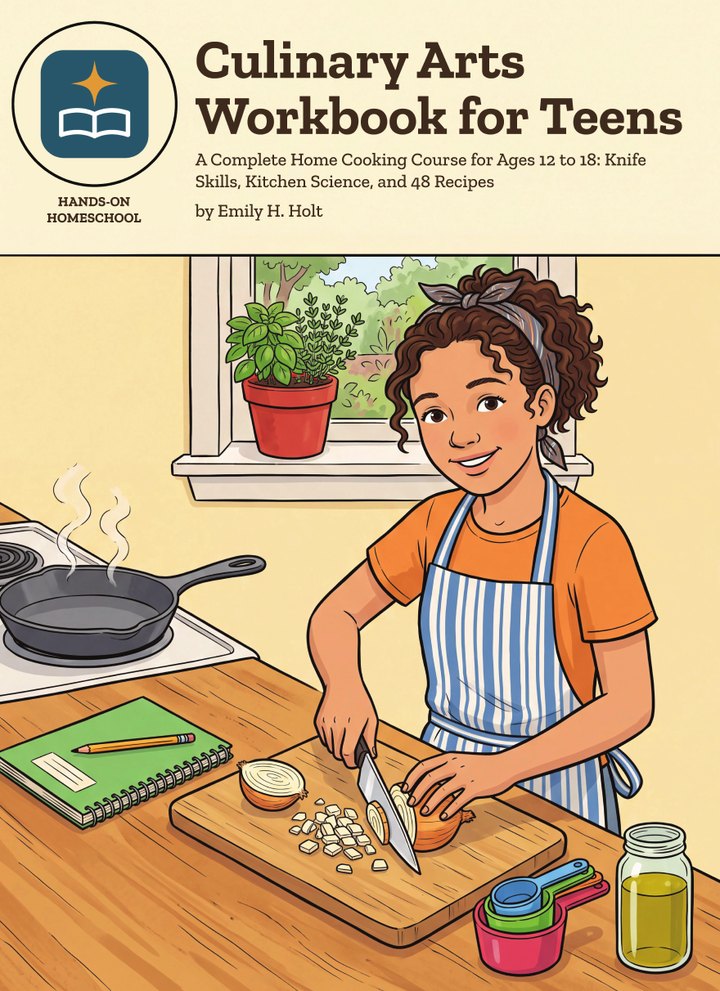
Culinary Arts Workbook for Teens
A full-year home cooking course for ages 12 to 18: 36 skill lessons, 48 recipes with serving scalers, Cook-and-Sign checks, and a transcript-ready one-credit elective. Also on Amazon.
See the Book