Teach a number, not a rule
Most of what kids hear about food is a rule: eat your vegetables, sugar is bad, drink water. Rules do not stick, because a kid cannot do anything with them except obey or not. What sticks is a measurement the kid made with their own hands. If you want to know how to teach kids about nutrition, the shortest answer is this: hand them a kitchen scale and a question, and let them write down what they find.
Every experiment below ends in a number or a ranking. Weigh it, count it, time it, or rate it from 1 to 5. The kid writes the result down. A scientist who does not write it down did not really do the experiment, and a kid who writes it down owns the finding.
Start with the new map
In 2026 the USDA and the Department of Health and Human Services gave their food guidance a new picture, and kids find it funny: the New Food Pyramid stands on its point. The wide top is split in two. One side is protein, dairy, and healthy fats: meat, chicken, fish, eggs, beans, milk, yogurt, cheese, nuts, olive oil, avocado. The other side is vegetables and fruits. The small point at the bottom is whole grains. Candy, soda, sugary cereal, and most packaged snacks are not on the pyramid at all. They are not a food group; they are sometimes foods. For kids 10 and under, the current guidelines recommend no added sugar at all.
Draw it on paper with your kid, then do the Kitchen Sort: pull twenty foods out of your pantry and fridge and sort them onto the pyramid. The ones that have no place on it are the first finding of the unit.
Experiment 1: Weigh the sugar in a soda
Kid-safe. Read the Nutrition Facts on a can of regular soda and find Total Sugars. Many cans list around 39 grams. Put an empty cup on a kitchen scale, press tare, and spoon white sugar in until the scale reads that number. Then divide the grams by 4, because a teaspoon of sugar is about 4 grams.
What a good result looks like: a startling little pile. Around 39 grams is nearly ten teaspoons. Stirred into water it would taste like very sweet lemonade; in soda the fizz and the sourness hide it. The kid now sees what the tongue could not.
Experiment 2: Label Detective
Kid-safe. Take any packaged snack. Find the serving size, then find how many servings are in the whole package. Write down sugar, fiber, and protein per serving, then multiply each by the number of servings. That is what you get if you eat the whole thing.
What a good result looks like: the whole-package numbers are often two or three times the per-serving numbers. A snack that looked like 8 grams of sugar becomes 24 once the kid notices there were three servings. Catching the serving-size trap is one of the most useful skills a kid can take out of a nutrition unit, and it works on every label for the rest of their life.
Experiment 3: The grease-spot test
Kid-safe. Cut open a brown paper grocery bag. Press a potato chip, an apple slice, a piece of cheese, a plain cracker, and a nut firmly onto their own spots and label each. Set it aside for an hour so the water dries. Then hold the paper up to a light. Fat leaves a spot that stays see-through; water dries and leaves nothing. Rank the five foods from biggest grease spot to smallest.
What a good result looks like: some foods leave clear, greasy, see-through spots and some leave almost nothing. The ranking is the result. Then check each label to compare how much fat each food really has. A grown-up okays the foods first against any allergies in the house, and cuts the apple and the bag.
Experiment 4: Float an egg
Kid-safe. Fill a tall glass with warm water and gently lower in an egg. It sinks. Take the egg out, stir in salt one spoonful at a time, counting, and let each spoonful dissolve before adding the next. Every few spoonfuls, test the egg again. Keep going until it floats.
What a good result looks like: after several spoonfuls the egg floats, because the salt made the water denser than the egg. It is the same reason it is easier to float in the ocean than in a pool. The number of spoonfuls is the result. Wash hands, glass, and spoon after the raw egg, and do not taste the salt water.
Experiment 5: Vitamin C Detective
Grown-up help. This one uses tincture of iodine from the first-aid aisle, which a grown-up handles, and nothing the iodine touches is ever tasted. Mix a little cornstarch into warm water and have the grown-up add iodine until it turns blue-black. Split it evenly into three clear cups. Into cup one, drip orange juice one drop at a time, stirring and counting, until the blue disappears. Do the same with apple juice in cup two and plain water in cup three. If a cup has not cleared after 40 drops, write "did not clear."
What a good result looks like: orange juice clears the color in the fewest drops, apple juice takes more, and plain water may never clear it. Fewer drops means more vitamin C. If the apple juice clears fast, read its label; apple juice with added ascorbic acid is fortified, and that is a true finding, not a failure. The grown-up pours every test cup down the sink at the end.
Turn it into a unit study
Five experiments make a two-week unit. One experiment a day is too fast for the finding to settle; two a week is about right. For each one: the kid states the question, runs the test, writes the number on a results log, and tells someone at dinner what they found. That last step is the grade. A kid who can explain the serving-size trap to a grandparent has learned it.
If you want the whole year, this is how Nutrition for Kids is built: one idea per chapter, one or more experiments that end in a measured result, a Parent Corner with the deeper science and the sources, and a small Brave Bites challenge for trying something new. Thirteen chapters, thirty experiments, and a tear-out results log in the back. The printable pages are free in the homeschool kit: the Tasting Sheet, the Experiment Results Log, and the Rainbow Plate chart, which turns counting food colors in a day into a game.
The rules before you start
Ask before you start, every time. Every experiment carries a tag: kid-safe means the kid can run it alone; grown-up help means heat, a sharp tool, or a reagent like iodine, and the grown-up does that part. Nothing from a chemistry test is ever tasted. Food allergies come first: the grown-up okays any food the kid will eat, and any food can be swapped for a safe one. The science still works. And the lab gets cleaned up, because a scientist leaves it better than they found it.
Questions parents ask
How do I teach kids about nutrition in a fun way?
Let them measure something. A kid who weighs 39 grams of sugar into a cup and sees that it is almost ten teaspoons has learned more about soda than any lecture can teach. Pick one experiment a week, keep it short, and have the kid write down the number.
What age is this for?
Ages 8 to 12. The experiments use a normal kitchen, a cheap kitchen scale, and pantry items, and a kid in that range can run most of them with a parent nearby. Anything with heat, a sharp tool, or iodine is tagged for grown-up help.
Is there a homeschool nutrition curriculum for elementary kids?
Nutrition for Kids is built as one: 13 chapters, 30 experiments, a Parent Corner at the end of each chapter with the deeper science and the sources, and tear-out result logs you can grade. The five experiments in this article are drawn from it.
Do I need special equipment?
No. A kitchen scale that reads grams, measuring spoons, cups, a notebook, and food you already have. Two experiments use tincture of iodine from the first-aid aisle, handled by the grown-up, and that food is thrown away, never eaten.
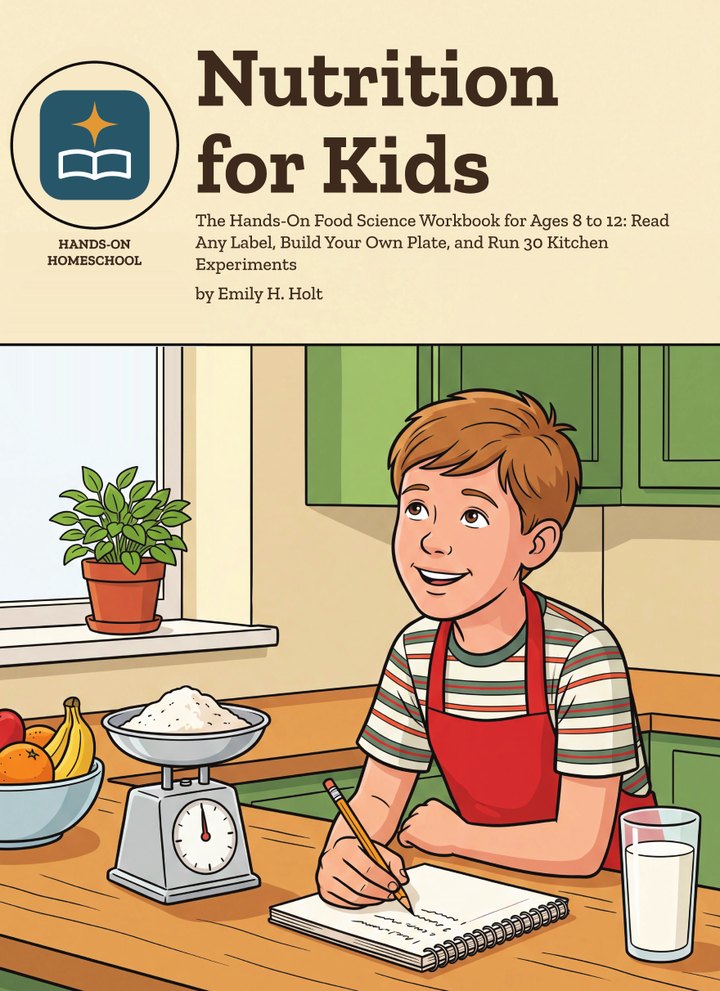
Nutrition for Kids
The hands-on food science workbook for ages 8 to 12: 13 chapters, 30 experiments with a measured result, Parent Corner notes, and tear-out logs you can grade. Also on Amazon.
See the Book