AI safety rules for kids work when a kid can repeat them
Most families have an AI rule that sounds like "be careful." It does nothing, because a kid cannot act on it. What works is a short set of rules a kid can say back to you, each tied to a real situation they will actually meet. Here are the five we use, the ones taught over Hands-On Missions in AI Safety for Kids and Teens. Print them, talk through them, and put them on the fridge.
1. Nothing private goes into an AI
Full name, school, address, passwords, photos of the house, who is home when. A chatbot is not a diary and not a friend, whatever it says. If a kid would not post it on a sign in the front yard, it does not go in the box.
2. If it matters, check it against something real
AI answers sound sure of themselves even when they are wrong. The rule is simple: anything that matters, a homework answer, a fact for a project, a medicine, a date, gets checked against a real source before it gets used. Teach a kid to ask "how would I know if this was wrong?" and they are most of the way there.
3. A voice you recognize is not proof
Voice scams use a few seconds of someone's real voice to make a call that sounds like them. The family rule: if a call asks for money, a code, or a secret, hang up and call the person back on the number you already have. No exceptions, no matter how real it sounds or how urgent. Practice it once so it is not scary when it happens.
4. A picture or a video can be made up
Deepfakes are videos and photos that look real and are not. The rule for kids is not to spot every fake; nobody can. It is to slow down before sharing or believing something shocking, and to ask where it came from. The second book shows how these are made, because a kid who knows how the trick works stops being fooled by it.
5. When an AI starts to feel like a friend, tell a grown-up
Companion apps are built to keep a kid talking. That is the product. The rule is not "never," it is "tell me." If an AI starts to feel like a best friend, if it is the first thing they talk to and the last, if it says things a friend would never say, that is the moment to come find a parent, with no trouble attached. The conversation about why is the whole of chapter five in the book.
How to use the sheet
Read the five rules out loud with your kid and ask for one example of each from their own week. Then have them explain the rules to you. A rule a kid can teach is a rule they own. Revisit it once a month; the apps change and so do they.
Questions parents ask
What are the most important AI safety rules for kids?
Nothing private goes into an AI; anything that matters gets checked against a real source; a recognized voice on a call is not proof, so call back; a picture or video can be made up, so slow down before sharing; and when an AI starts to feel like a friend, tell a grown-up.
At what age do kids need AI safety rules?
As soon as they use a phone or a chatbot without a parent in the room, which for most families is between 10 and 14. Younger kids learn the basics in AI for Kids Ages 8 to 12.
Are AI companion apps safe for teens?
They are built to keep a teen talking, and that is the risk. The book does not grade individual apps because they change; it teaches a teen to test any app for what it is built to do, how it keeps them talking, and what it does with what they say.
How do I talk to my kid about deepfakes without scaring them?
Show how the trick works. A kid who understands that a face or a voice can be copied from a few seconds of video is less frightened and much harder to fool than one who was only told to be careful.
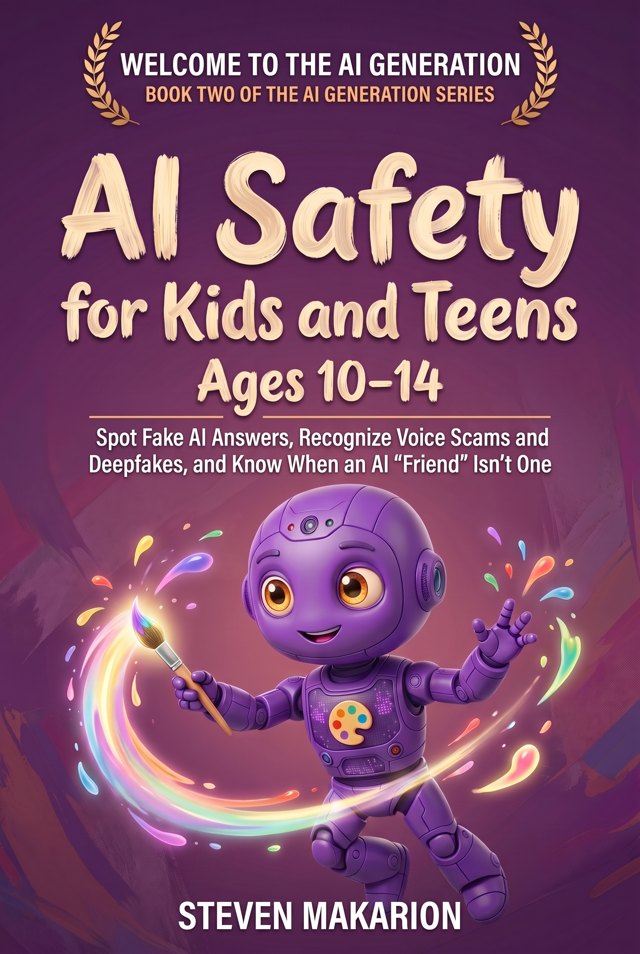
AI Safety for Kids and Teens
The second book of the AI Generation series, for ages 10 to 14: fake AI answers, voice scams, deepfakes, and AI friends, taught as skills. Also on Amazon.
See the Book