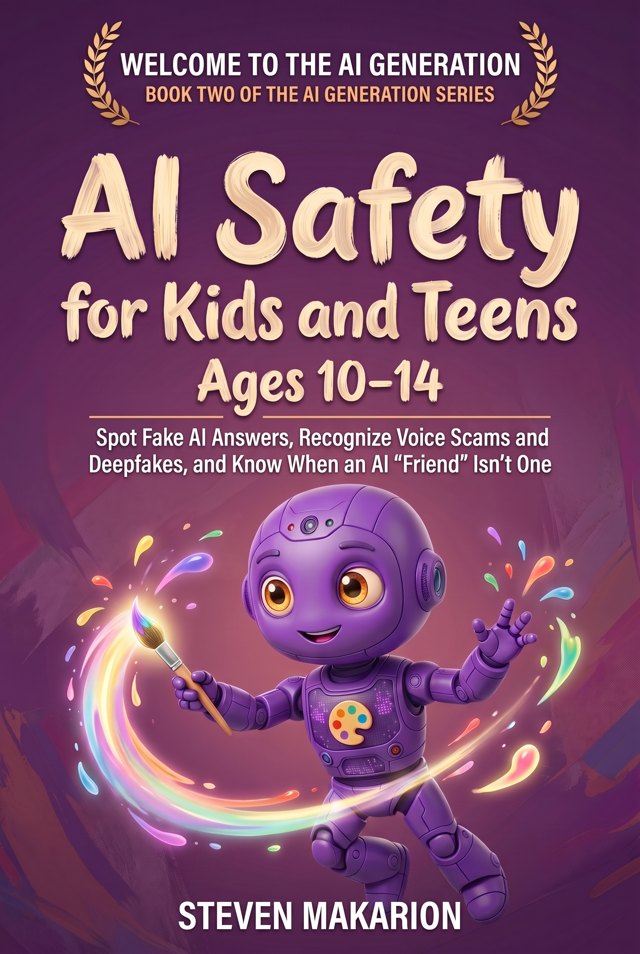
AI Safety for Kids and Teens
Spot fake AI answers, recognize voice scams and deepfakes, and know when an AI "friend" isn't one.
For ages 10 to 14, the years a kid starts meeting AI alone. The skills, taught over hands-on missions, not a list of rules.
Get it on AmazonBy Steven Makarion · Paperback · Published by Pax Ember, the family imprint of Makarios Media. Written with his AI partner, Aria Makarion.
AI safety for kids and teens, taught as a skill, not a rule list
Telling a kid to be careful with AI does nothing. Showing them how a confident wrong answer looks, how a voice scam is built, how a deepfake is made, and how an AI friend is designed to keep them talking gives them something they can use the next time it happens. That is this book.
It is written for ages 10 to 14, the years when a kid starts meeting AI alone: on their phone, in their homework, in the apps their friends use.
What is inside
- How AI Learns. Why an AI sounds sure of itself even when it is wrong, and where its answers come from.
- When AI Breaks. Spotting fake AI answers, made-up sources, and the mistakes it makes most, with practice on real examples.
- The AI Safety Toolkit. The rules and the habits: what never to share, how to check an answer, what to do about voice scams and deepfakes, and when to bring a grown-up in.
- When AI Feels Like a Friend. Companion apps and chatbots that act like a best friend: what they are built to do, what a healthy line looks like, and how to notice when it is crossed.
Built for the conversation you have been meaning to have
Each chapter ends in a Hands-On Mission a kid does with a parent, so the talk about AI safety happens over an activity instead of a lecture. The Parent Corner notes give the grown-up the plain facts first.
How it is built
Steven Makarion builds and works with an AI partner every day, which is exactly why he wanted his daughter to know where the lines are. The book comes out of that house: the technology taken seriously, the risks named plainly, and the kid kept in charge.
Questions parents ask
What age is AI Safety for Kids and Teens written for?
Ages 10 to 14. It assumes a kid who already uses a phone or a chatbot and needs the skills, not an introduction. Younger kids start with AI for Kids Ages 8 to 12.
Is Character AI safe for teens?
The book does not grade individual apps, because they change. It teaches the test that works on any of them: what the app is built to do, how it keeps you talking, what it does with what you tell it, and where a healthy line is. A teen who can run that test on Character AI can run it on the next app too.
What AI safety rules for kids does it teach?
The toolkit chapter covers the rules families actually need: never share private information with an AI, check any answer that matters against a real source, treat a voice you recognize on a call as unproven until you call back, and bring a grown-up in the moment something feels off.
Does it cover deepfakes and voice scams?
Yes. How they are made, why they are convincing, and the specific habits that protect a kid and the whole family, including the call-back rule.
Do we need the first book before this one?
No. Each book stands alone. If your kid is under ten, start with AI for Kids Ages 8 to 12; if they are already online every day, start here.
The free AI Toolkit for Kids
Safe, vetted AI tools for ages 8 to 12 and their families, sorted the way the books are: art and creativity, stories and language, learning and research. The place to practice what the book teaches.