Boys Build Friendships Shoulder to Shoulder
Watch two ten-year-old girls become friends and you'll usually see a lot of talking: face to face, trading secrets, narrating their lives to each other. Watch two ten-year-old boys become friends and you'll see something different. They're building a fort. They're arguing about a video game. They're taking turns on a bike ramp. The friendship forms sideways, while both of them are looking at the thing they're doing, not at each other.
This is the single most useful fact for a parent worried about a son's social life. Boys, broadly, bond through shared activity. The talk comes later, riding on top of the doing. Which means "go make friends" is close to a meaningless instruction for most boys, while "come play this" does almost all the work by itself.
"Go make friends" is close to meaningless for most boys. "Come play this" does almost all the work by itself.
It also means that if your son struggles here, the fix usually isn't personality surgery. It's logistics. Most boys who lack friends don't lack likability. They lack repetitions: regular, low-stakes chances to be around the same kids doing something they both care about. Repetition is where familiarity comes from, and familiarity is where friendship comes from. You can engineer repetition. Here's how.
How to Engineer Low-Pressure Friendship Reps
Think of yourself less as a social coach and more as a groundskeeper. You cannot make a friendship grow. You can make the conditions right and let it happen. Three moves matter most.
Move 1: Get Him One Weekly Thing
A team, a club, a class, a scout troop, a robotics group, a martial arts gym. What it is matters far less than three properties: it meets every week, the same kids show up, and there is a shared activity at the center so nobody has to generate conversation from nothing.
Pick it from his actual interests, not from what you wish his interests were. A boy who loves games will make friends at a chess club or a D&D table and go silent in a soccer league he got signed up for. The activity is the bridge; it only holds weight if he actually wants to be on it.
Then give it time. Ten or twelve weeks of the same faces, minimum, before you judge whether it's "working." Friendship at this age runs on accumulated hours, and there is no shortcut through the accumulation.
Move 2: Become the Easy House
One-on-one time is where an acquaintance from practice turns into an actual friend, and someone's parent has to make that happen. Let it be you. Make invites frictionless: you offer the ride, you supply the pizza, you keep the plan short. Ninety minutes, one activity, done.
And build the invite around a thing, because that is the shoulder-to-shoulder rule again. Not "do you want to hang out," which puts two boys in a room to stare at each other, but "we're getting pizza and watching the game Saturday, want to come?" The activity gives the afternoon a spine. If it goes quiet, there's still the thing.
One more secret: teach him that the invitation itself is the skill. The kid who invites is the kid who ends up with friends, because almost nobody else's family is doing this on purpose. Being the one who asks feels risky and is actually a superpower.
Move 3: Let Small Conflicts Get Repaired, Not Avoided
Boys' friendships hit friction constantly: the disputed call, the trash talk that went too far, the turn that never got shared. Parents instinctively separate kids when this happens. Resist it when the conflict is small. Working through friction with the same kid, and still playing together next week, is the actual material friendship is made of.
What he needs from you is the repair move, taught once and practiced: name what happened, own your piece, offer the restart. A boy who can say "my bad, that was a cheap shot, rematch?" will keep friends his whole life. That skill is teachable at the dinner table, and we walk through the full version in our guide to teaching your son social skills.
What to Say When He's Discouraged
Sooner or later comes the hard night: "Nobody likes me." "I have no friends." "Everyone already has a best friend." Every instinct you have will push you to argue with the feeling, list his wonderful qualities, or fix it on the spot. All three usually make a boy shut the door.
Try this sequence instead. First, sit with it: "That sounds really lonely. I've felt that too." No pivot, no silver lining, not yet. Boys get so little practice having a feeling witnessed without someone immediately managing it.
Second, shrink the claim. "Nobody" and "everyone" are the vocabulary of discouragement, not description. Gently get specific: "Nobody, like the whole grade? Or lunch has been rough this week?" Usually the true version is smaller: one table, one group, one kid who moved on. A small true problem can be worked. A giant vague one can only be suffered.
A small true problem can be worked. A giant vague one can only be suffered.
Third, aim him at one rep, not at the mountain. Not "you just need to put yourself out there," which is the mountain, but "who's the one kid at robotics you'd want on your team? Invite him for pizza Saturday, I'll drive." You are converting despair into a next move, and a next move is the thing a discouraged kid can actually hold.
Last, tell him the honest math: most people, kids and adults, have one to three real friends, not a crowd. The movie version of the packed lunch table is marketing. One good friend is not a consolation prize. It is the actual prize.
Books About Friendship for Boys: What to Look For
Books earn their place in this project two different ways. Story books, novels where boy characters wrestle with real friendship problems, let your son watch the moves from a safe distance and discover he's not the only one finding this hard. Skills books teach the moves directly: how to join, how to invite, how to repair.
For the skills kind, the bar to insist on: concrete steps a real kid could run this week, missions that leave the page, and a voice that talks to boys like they're capable, not broken. We wrote a full honest buying guide in Social Skills Books for Kids: What Actually Works, including the sixty-second checklist we apply to our own titles.
Ours is Social Skills for Boys, for ages 8 to 12, part of the Life Skills for Kids series. The friendship chapters cover exactly the ground above: joining a game already in progress, making the invite, keeping a friend through a fight, with a Hands-On Mission to run each week and a Parent Corner that hands you the debrief. It's built for the boy who would rather take on a challenge than sit through a talk, because in our experience that is most of them.
When to Worry, and When to Wait
Most friendship droughts at this age are seasonal: a best friend moves, a class shuffle splits a group, an interest changes and the old crew doesn't follow. Given a weekly activity and a few engineered reps, most boys find their footing again in a season or two. Slow is normal here. Boys' social lives often look sparse from the outside while being fine on the inside.
Talk to his teacher or pediatrician if you see the bigger flags: he's actively excluded or targeted, not just unnoticed; he's lost interest in things he used to love; the loneliness talk is constant for months rather than an occasional hard night; or he genuinely cannot manage any peer interaction without blowups. Those patterns deserve more support than logistics can provide, and getting that support early is a strength move, not an alarm bell.
For everything short of that: a weekly thing, an easy house, a taught repair move, and a parent who sits with the hard nights before fixing them. That's the whole playbook. It is unglamorous, it takes a season, and it works.
Give Him the Playbook
Social Skills for Boys teaches the joining, inviting, and repairing moves above as Hands-On Missions your son runs one rep at a time, with a Parent Corner so you always know what to say afterward. Ages 8 to 12.
See Social Skills for BoysWant to start free? Get the free Life Skills Toolkit or browse all our books.
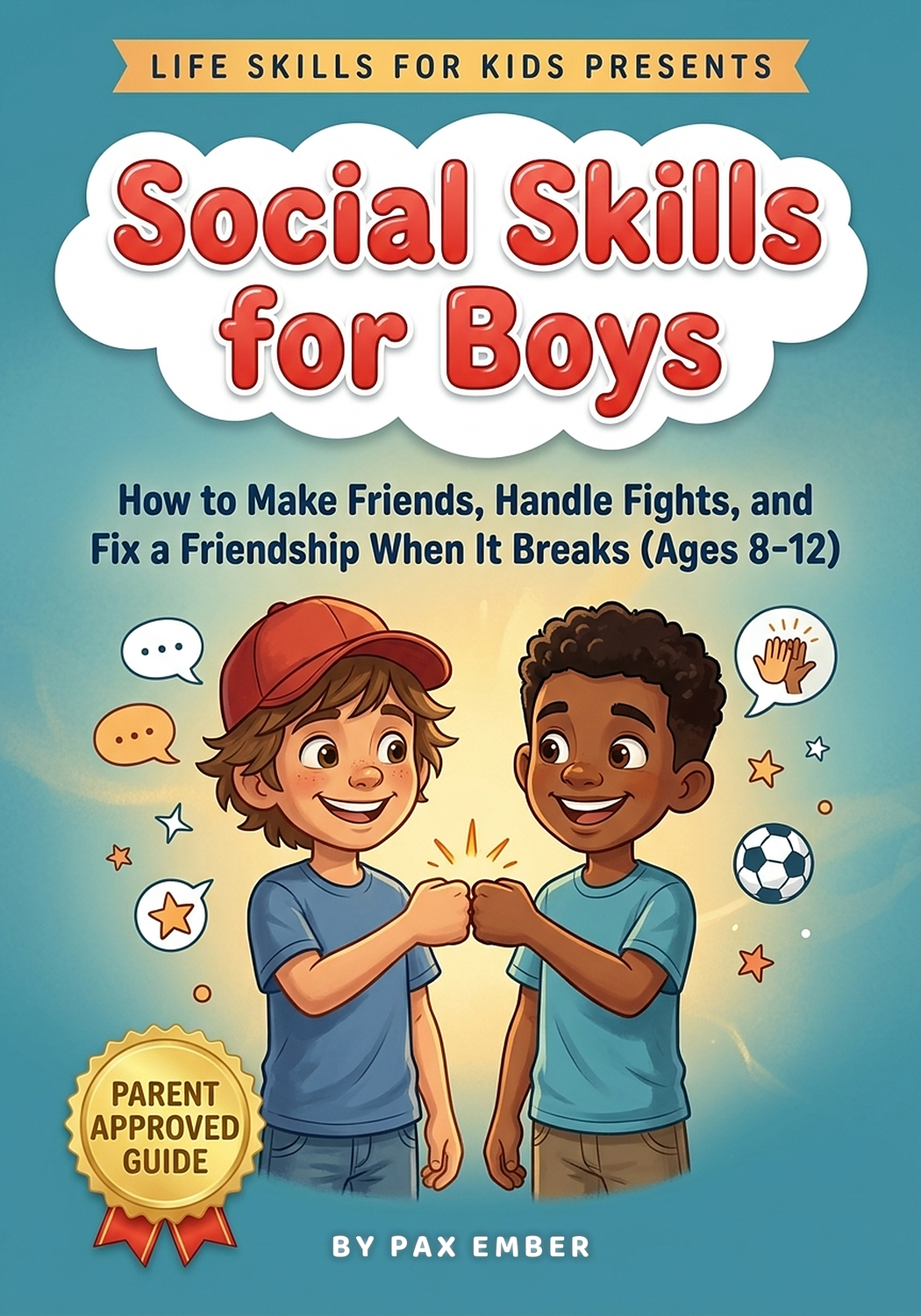
Social Skills for Boys (Ages 8-12)
Part of the Life Skills for Kids series. Joining games, making invites, handling teasing, repairing fights: one skill per chapter, a Hands-On Mission to try in real life, and a Parent Corner with your side of the play.
Get It on Amazon