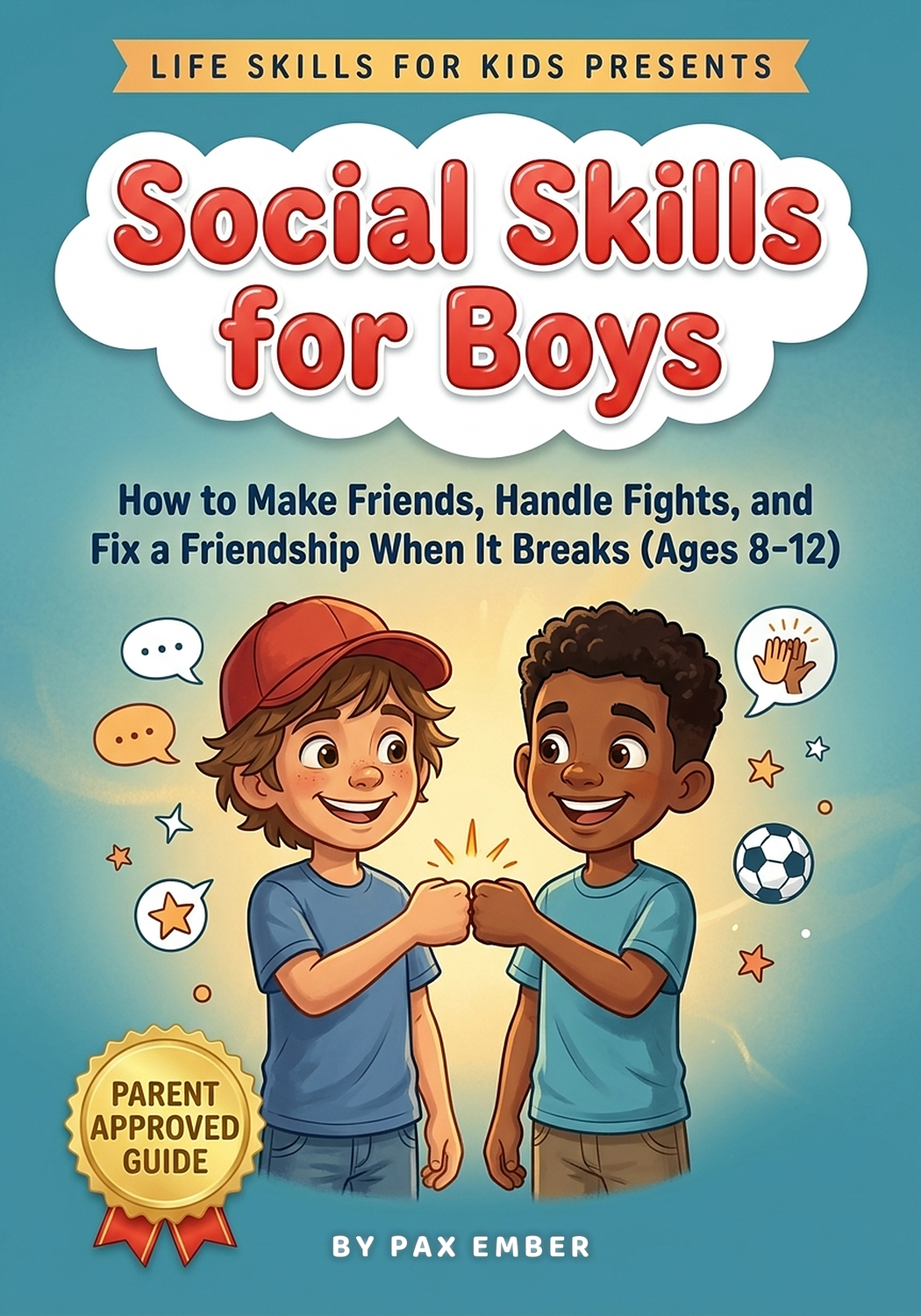
Social Skills for Boys
Making friends, reading a room, and repairing things when they go sideways. A hands-on workbook for boys ages 8 to 12 who want friendship to feel less like a mystery.
No lectures. No "just be yourself." Real moves a boy can try this week, one mission at a time.
Get it on AmazonWhy a social skills book just for boys?
Most friendship books talk about feelings first and actions second. A lot of boys work the other way around. They want to know what to do: what to say when you walk up to a group, how to tell a joke that lands without landing on someone, what to do when your best friend suddenly acts like you don't exist.
Social Skills for Boys starts with the doing. Every skill is broken into steps you could write on an index card. The feelings show up too, but they show up the way boys actually meet them: in the middle of a real situation, with a real move available.
If you have searched for books about friendship for boys and found shelf after shelf of picture books for little kids, this is the one written for the 8 to 12 stretch: old enough for group chats and team tryouts, young enough that the patterns he builds now become the default for middle school and beyond.
How to teach your son social skills without lecturing
Here is the honest answer to the question parents type into Google at 11 PM: you mostly can't tell a boy into better social skills. Talking at him about friendship works about as well as talking at him about free throws. What works is reps.
That is the whole design of this workbook:
- Short chapters he reads himself. Direct, funny, and written to him, not about him.
- Step-by-step tools. How to join a game already in progress. Three ways to start a conversation that aren't "hi." What to say after you lose. How to apologize so it actually counts.
- Hands-On Missions. Each chapter ends with one real-world mission with clear success criteria. He tries it at school, at practice, or at a birthday party, then checks it off.
- Parent Corner. Your two pages per chapter: what this skill looks like at his age, what to say instead of a lecture, and one question worth asking at dinner.
You are not the instructor. You are the person he debriefs with. That one shift is why workbooks beat lectures.
What's inside
- Making friends: where friendships actually start, and the small first moves that work even for quiet kids
- Joining in: how to read a group before you walk up, and what to do once you're there
- Reading the room: faces, tone, and timing, practiced like a skill instead of assumed like magic
- Teasing and conflict: the difference between joking with someone and joking at them, and what to do about each
- Losing well: being someone people want on their team even when the team loses
- The repair kit: how to fix a friendship after a blow-up, including the apology that isn't "sorry you got mad"
- Friends online: group chats, games, and being the same good friend on a screen that you are in person
Every chapter follows the same rhythm: the skill, the steps, a Hands-On Mission with success criteria, and a Parent Corner.
Questions parents ask
How do I teach my son social skills?
The same way he learned to ride a bike: practice, not lectures. This workbook breaks friendship into small, concrete moves he can try this week, then gives him one Hands-On Mission per chapter to run in real life and talk over with you after.
What age is this for?
Boys ages 8 to 12. The examples live where they live: recess, group projects, team sports, birthday parties, and the first group chats.
Will it help a shy or quiet boy?
Yes. Nothing in the book asks him to become louder. It gives him first moves that work at any volume, and treats listening as a strength he may already have.
What about boys with ADHD or autism?
Many families like the format for exactly that reason: everything is concrete, chapters are short, and there is one clear mission at a time. It is a practice workbook, not a therapy program, so it fits alongside whatever support your family already uses.
Do I work through it with him?
He owns the book. You get the Parent Corner: about ten minutes per chapter, with the one dinner-table question that keeps the conversation going without turning into a lesson.
Part of the Life Skills for Kids series
Social Skills for Boys sits alongside the age-by-age Life Skills books, Money Skills for Kids, AI Skills for Kids, and Big Feelings, Real Tools. Same rhythm in every book: real skills, hands-on missions, and a Parent Corner that keeps you in the loop without putting you in charge.
Reading with a younger or older kid? Browse the full library to find the right fit.
Get the free companion tools
Grab the free Pax Ember toolkits, plus new-book news and practical tips for raising capable kids.