Why Most Social Skills Books for Kids Sit on the Shelf
Here's the pattern. You search "social skills books for kids," pick one with good reviews, and hand it over with high hopes. Your kid reads a chapter, maybe two. The book migrates to the floor, then under the bed. Three months later you find it while looking for a missing shoe, and nothing about lunchtime has changed.
We publish children's books, so believe us when we say this is not a kid problem. It is a book problem, and it has a specific cause: most books that teach social skills are written like little textbooks. They explain what empathy is. They describe what good listening looks like. They tell the kid to be confident. All true, none of it usable, because knowing what a skill is and being able to run it under pressure are two different things.
Knowing what a skill is and being able to run it under pressure are two different things.
An 8 to 12 year old does not need a better explanation of friendship. He needs to know exactly what to say when three kids are already playing and he wants in. The books that work are built around that difference. Here are the four things they get right.
1. Concrete Steps, Not Character Traits
Open any social skills book to a random page and check what the advice looks like. Weak books deal in traits: "be a good listener," "show kindness," "respect personal space." A kid cannot do a trait. There is no first move.
Strong books deal in steps. Not "be a good listener" but "when your friend is talking, wait until he finishes, then ask one question about what he just said." Not "handle teasing well" but "look bored, say 'okay,' and walk toward something else." Steps have a beginning. A kid standing in a hallway can run a step. He cannot run a virtue.
This is the fastest test you can apply in a bookstore or an Amazon preview: find one piece of advice and ask, could a nervous ten-year-old execute this in the next sixty seconds? If the answer is no, keep looking.
2. Missions That Leave the Page
Reading about swimming does not make a swimmer. The best social skills activity books know this, and they end every chapter with an assignment that happens away from the book: ask one question of a kid you don't know at practice. Give one real compliment today. Join one game at recess using the steps you just read.
Two details separate a real mission from filler. First, it is small enough to actually attempt. "Make a new friend this month" is a wish. "Ask one kid one question tomorrow" is a mission. Second, it has a way to tell whether you did it. Kids this age love checking a box they genuinely earned, and a completed mission is proof to the kid himself that he is the kind of person who can do this.
Worksheets, by contrast, keep the practice at the table. Fill-in-the-blank pages have their place in a therapy setting with a professional guiding them, but for a typical kid at home, a workbook page about feelings is still homework. A mission is a dare. Boys especially take dares.
3. A Voice That Respects the Kid
Kids ages 8 to 12 have the most sensitive condescension detectors on earth. The moment a book sounds like a worried adult crouching down to their level, it's finished, no matter how good the content is.
The voice that works talks to kids the way a good coach does: direct, a little funny, honest that the hard parts are hard. It says "walking up to a group is scary, here's the move anyway" instead of pretending fear isn't real or, worse, drowning the kid in reassurance. It treats the reader as someone capable of doing difficult things, because that assumption is half the teaching.
A book that respects the kid assumes he can do hard things. That assumption is half the teaching.
Read one page aloud before you buy. If you would be mildly insulted hearing it at your kid's age, so will he.
4. A Parent Track That Tells You What to Do
Here's the piece almost everyone overlooks: what happens after the chapter. The skill gets built in the follow-through, in the practice and the debrief, and most books leave you to improvise that part. You end up hovering, or quizzing, or letting it drop entirely.
The best books that teach social skills include a parent sidebar in every chapter: what the chapter taught, what the mission is, what to ask afterward, and what not to say when the attempt goes sideways. That last one matters most. When your son reports that he tried to join the game and got shrugged off, the difference between "oh no, honey" and "okay, first rep is always the roughest, what would you run differently?" is the difference between a kid who tries again and one who doesn't.
A parent track turns the book into a shared project instead of an assignment. The kid gets the missions. You get the coaching notes. Nobody is lecturing anybody. We wrote more about that division of labor in our guide to teaching your son social skills: the short version is that the book instructs so you can be the debrief partner, which is the job only you can do.
The Sixty-Second Checklist Before You Buy
- Steps test: open a random page. Could a nervous ten-year-old run the advice in the next minute?
- Mission test: does each chapter end with a small real-world assignment, not just a worksheet?
- Voice test: read a paragraph aloud. Would it have insulted you at ten?
- Parent test: does the book tell you what to do after each chapter, or leave you guessing?
- Fit test: is it written for your kid's actual age band? A book aimed at ages 4 to 8 will die on contact with an eleven-year-old.
Any book that passes all five is worth your money, whoever publishes it. Plenty of good ones exist, including workbooks by child therapists that shine in counseling settings. Match the tool to the kid.
The One We Publish: Social Skills for Boys
Full disclosure, since this is our blog: we publish one, and we built it to pass every test above because we kept seeing books that didn't.
Social Skills for Boys is part of our Life Skills for Kids series for ages 8 to 12. Every chapter teaches one skill in concrete steps: joining a group, starting conversations, reading the room, handling teasing, apologizing for real, being a good winner and a decent loser. Every chapter ends with a Hands-On Mission, a small real-world rep with clear success criteria. And every chapter includes a Parent Corner that hands you the debrief questions and the things not to say. The voice is coach, not counselor, because that is the voice boys this age actually accept.
It is written for boys specifically because the friction points differ: boys' social lives run through games, teams, and doing things side by side, and generic books tend to miss that. If friendship itself is the sore spot for your son, start with our companion piece on helping boys make friends and see how the pieces fit together.
And if you'd rather sample the approach before buying anything, the free Life Skills Toolkit below gives you a real taste of how missions and parent notes work. Either way, apply the checklist. Your kid deserves a book he'll actually use, and now you know how to spot one.
See the Approach for Yourself
Social Skills for Boys puts concrete steps, Hands-On Missions, and a Parent Corner in every chapter, for ages 8 to 12. Start with the book, or try the free Life Skills Toolkit first and see how mission-based learning feels at your house.
See Social Skills for BoysWant the free start? Get the Life Skills Toolkit or browse all our books.
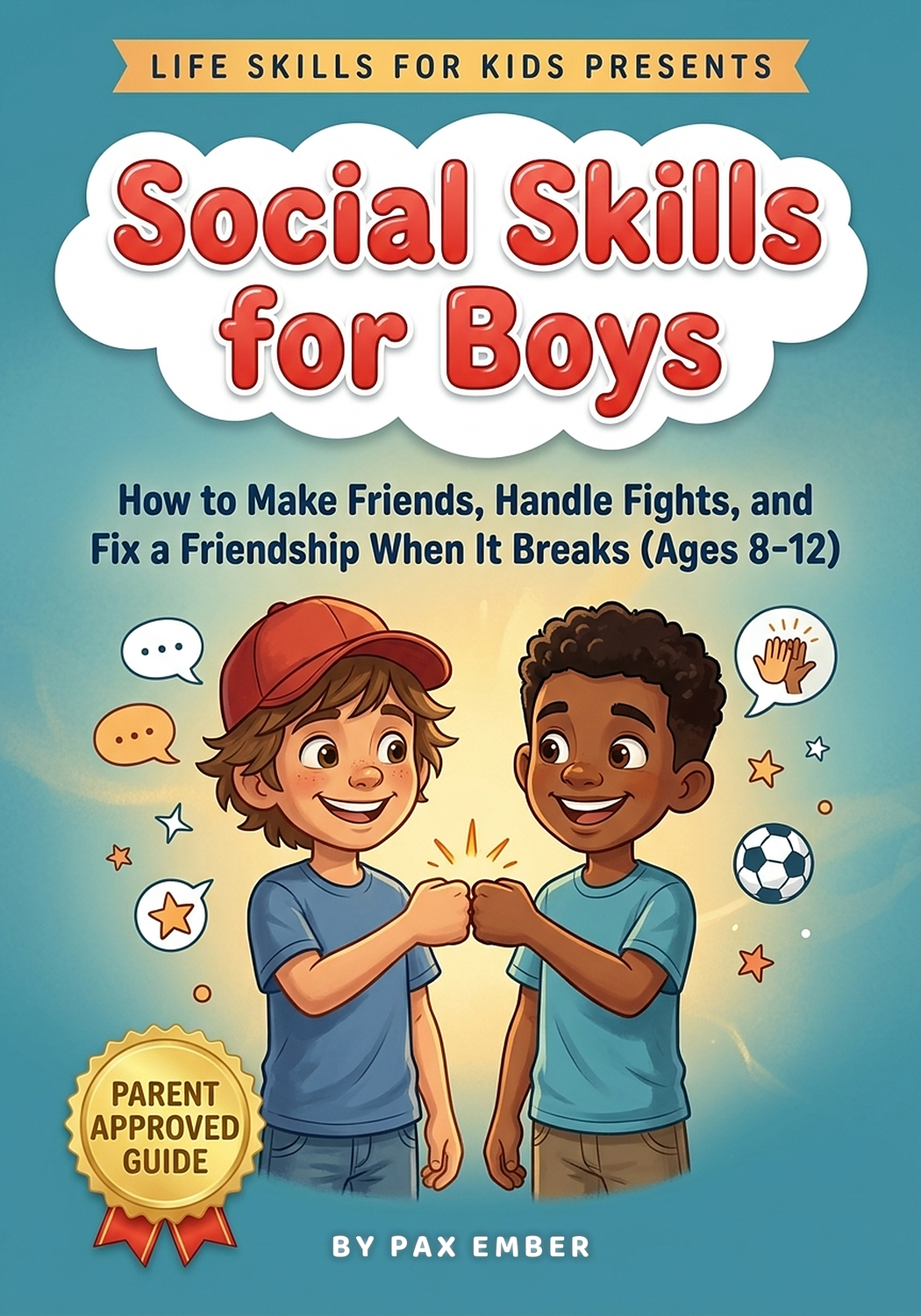
Social Skills for Boys (Ages 8-12)
Part of the Life Skills for Kids series. One skill per chapter in concrete steps, a Hands-On Mission to run in real life, and a Parent Corner so you always know your next move. Coach voice, zero condescension.
Get It on Amazon