Anger Is Information, Not Defiance
If you typed "how to help my child with anger" into a search bar tonight, odds are you just lived through something loud. A slammed door. A homework page torn in half. Words from your sweet kid's mouth that landed like a slap. And the question underneath the search is scarier than the search: is something wrong with my child?
Start here: anger is information. In kids, it almost always points at one of two things. Something feels unfair (the sister got more screen time, the referee blew the call, the teacher singled them out) or something is blocked (the tower fell again, the level won't beat, the plan got cancelled). Unfair or blocked. Read a week of your kid's outbursts through that lens and a pattern usually appears fast.
Anger is the messenger, not the message. Kill the messenger and the message finds a louder way in.
This matters because it changes your target. A parent fighting the anger itself is fighting the smoke alarm. A parent reading the anger gets to find the actual fire: the friendship going sideways, the math unit that suddenly got hard, the little brother who wrecks everything he builds. The anger was never the problem. It was the report about the problem, filed by a kid who does not yet have a calmer way to file it.
And that calmer way is buildable. Not by making your child less fiery. By giving the fire somewhere to go.
Catch It on the Way Up, While It's Still a Spark
Here is the most useful mechanical fact about childhood anger: it is not a light switch, it is a ramp. Before the explosion there is always a run-up. Jaw tightens. Hands fist. The voice climbs. Answers shrink to one word. Some kids go silent and still, like weather before a storm.
On the low end of that ramp, your kid can still think, choose, and use a tool. At the top, the thinking brain has left the building. So the entire game of helping a child control anger is played early: notice the spark, act at the spark, because nobody, adult or child, does their best work at full flame.
Teach the noticing directly, in a calm moment. Ask: what happens in your body right before you get really mad? Kids know. Hot ears. Tight chest. "My hands want to squeeze." Give those signals a shared family name (we call it "the rumble" at our house, some families say "the volcano waking up") so either of you can flag it without accusation. "I think the rumble is starting. Want your minute?" lands completely differently than "You'd better calm down."
The Cool-Down Routine Your Kid Builds (Not You)
Every anger plan needs a release valve: a short, known routine that drains the spark before it becomes a fire. Movement works for lots of kids (wall pushes, stomping down the hallway, a fast bike loop). Cold water works. Slow breathing works if it was practiced beforehand. Getting away from the trigger for two minutes almost always works.
But the routine only works under one condition: the kid built it. A cool-down routine assigned by a parent is a punishment with better branding, and kids treat it accordingly. A cool-down routine the kid designed, tested, and named is theirs, and kids defend what is theirs.
A cool-down routine assigned by a parent is a punishment with better branding. A routine the kid built is theirs.
So build it together, on a calm afternoon, like a fire drill before any fire. Let your kid pick three candidate moves and test them during small frustrations first. Let them choose the spot, the phrase, the order. Then practice the whole sequence twice while nobody is angry, because rehearsal while calm is the only reason a tool shows up during the storm. This build-it-yourself approach is the entire spine of Big Feelings, Real Tools: the anger chapters walk kids ages 8 to 12 through mapping their own warning signs and constructing their own cool-down plan as Hands-On Missions, with a Parent Corner that tells you how to back the plan instead of running it.
What Pours Gas on the Fire
Most of us make angry moments worse in the same three ways, with excellent intentions.
- Logic mid-storm. "Buddy, it's just a game, and you can play again tomorrow." True, reasonable, useless. A flooded brain cannot process reasoning, so mid-storm logic reads to your kid as "you are wrong to feel this," which is a fresh injustice, which is fresh fuel.
- "Calm down." Nobody in the history of the phrase has calmed down because of the phrase. It tells the kid the feeling is the offense, hands them zero tools, and usually arrives in a voice that is not calm either.
- Punishing the feeling instead of the behavior. This is the one with the longest tail. Throwing the controller can absolutely have a consequence. Feeling furious cannot. When the feeling itself gets punished, kids do not stop feeling angry. They stop showing you, and anger you cannot see is anger you cannot help with. It goes underground and comes back as sarcasm, stomachaches, or a blow-up over nothing three weeks later.
What replaces all three is smaller than you'd think: stay near, keep everyone safe, say one short thing ("You're really angry. I'm right here."), and let the wave pass. You are not doing nothing. You are lending your kid a calm nervous system until theirs comes back online, and that loan is the most effective move a parent has mid-storm.
The Repair Conversation After
The learning never happens during the anger. It happens in the quiet afterward, and it has a shape.
First, reconnect. A snack, a shoulder squeeze, a few minutes of nothing. Your kid needs to know the relationship survived before they can think about what happened.
Then, get curious together. Not "why did you do that" (no kid has ever answered that question well) but "what was the unfair thing?" or "what got blocked?" You are teaching them to read their own messenger.
Then, repair what the behavior broke. If words hurt someone, an apology. If something got thrown, it gets picked up. Repair is not humiliation and it is not optional. It teaches the real rule: your anger is welcome here, and it is still your responsibility.
Last, upgrade the plan. One question: what could the rumble-move be next time? Then actually practice it once. That single rep, done while calm, is worth more than the whole lecture you were tempted to give.
Two honest notes before the end. This takes dozens of repetitions, not three, and your kid will blow past the plan plenty of times while the skill grows, which is normal and not evidence that it is failing. And a workbook is skills practice, not therapy: if your child's anger is constant, frightening, or getting worse despite steady support at home, a pediatrician or children's therapist belongs on the team alongside any book, including ours.
Anger is one wave in a bigger ocean, and the same names-first, tools-while-calm approach works across all of it. We wrote a companion piece on the wider picture: how to help kids with big emotions. Both grew out of the same workbook, and both start from the same conviction you can find across our whole Life Skills for Kids series and the rest of the blog: kids don't need smaller feelings. They need real tools.
Give Your Kid the Tools Before the Next Storm
Big Feelings, Real Tools walks kids ages 8 to 12 through building their own warning-sign map and cool-down routine, mission by mission. Start with the free Big Feelings Toolkit and see how your kid takes to it.
See Big Feelings, Real ToolsOr grab the free Big Feelings Toolkit: printable feelings vocabulary, body map, and calm-down checklist.
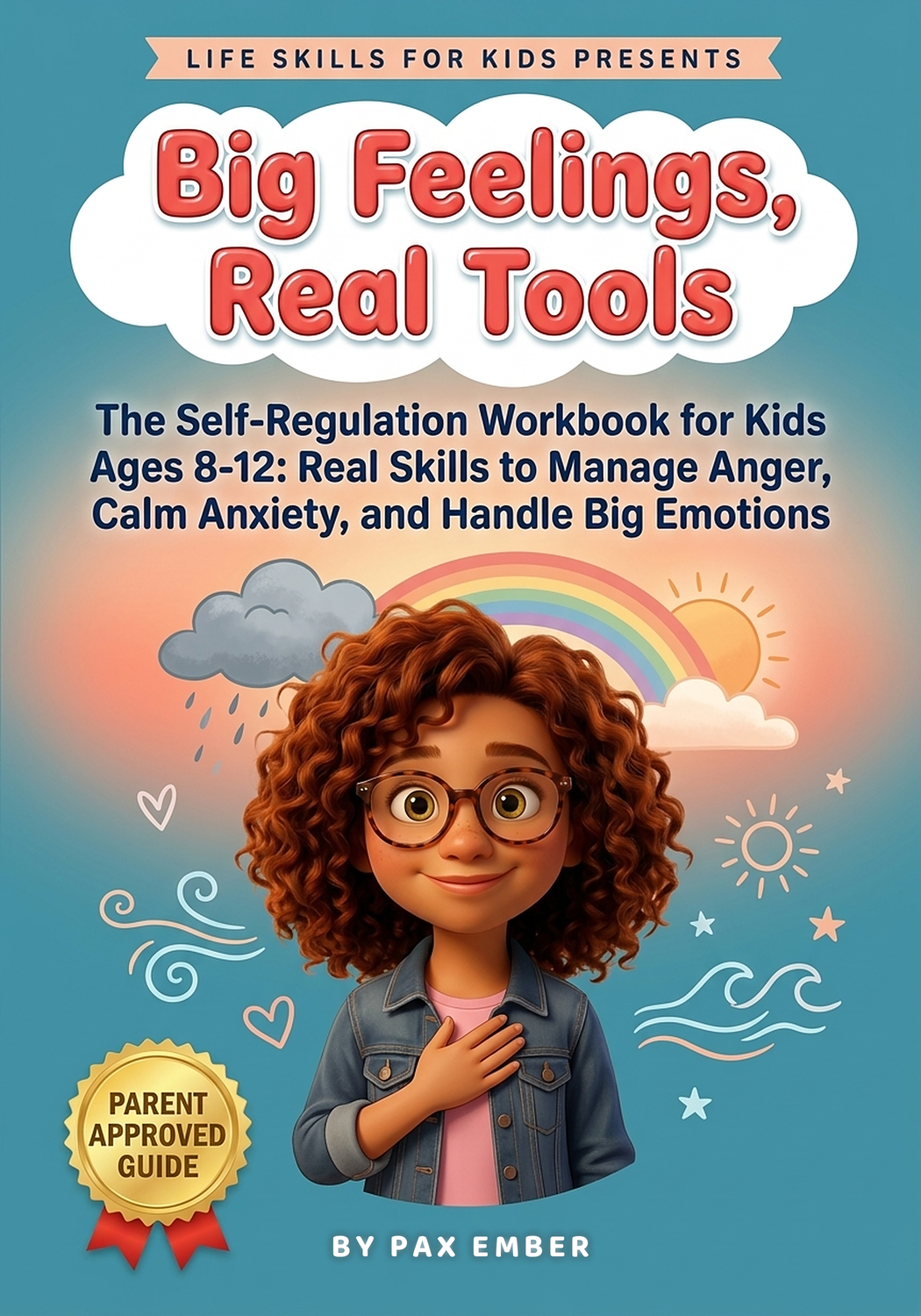
Big Feelings, Real Tools
The emotional skills workbook for kids ages 8 to 12, from the Life Skills for Kids series. Hands-On Missions kids complete themselves, Parent Corner guides for you, and an anger plan your kid actually owns. Also on Amazon.
See the Book