The Feeling Is Not the Emergency
Your nine-year-old is on the kitchen floor because the tablet died mid-game. The volume is enormous. The reason seems tiny. And somewhere in your chest, a small alarm is going off: something is wrong with my kid.
Here is the reframe that changes everything about helping kids with big emotions: the feeling is not the emergency. Kids are supposed to have big feelings. Rage, grief, jealousy, dread about a spelling test, joy so loud it knocks over a lamp. A big feeling in a small body is not a malfunction. It is childhood.
The actual emergency is empty hands. A kid hit by a wave of fury who has no name for it and no tool for it has exactly one option: let it out through the body. Screaming, slamming, hitting, hiding. Not because the kid is bad. Because the kid is unequipped.
A kid with a big feeling is not broken. A kid with a big feeling and nothing to do with it is just unequipped.
That distinction matters because it changes what you are trying to fix. You cannot make the waves stop. You would not want to. What you can do is put something in your kid's hands before the next wave arrives. That is what emotional regulation for kids actually means: not fewer feelings, better equipment.
Why Naming Feelings Comes Before Managing Them
There is an order of operations here, and most of us get it backwards. We jump straight to managing: take a deep breath, count to ten, go to your room until you can be calm. But you cannot manage what you cannot name.
Think about the difference between "I feel bad" and "I'm disappointed because I practiced all week and still didn't make the team." The first is a fog. The second is a thing with edges. A kid who can say "disappointed" instead of "bad" has already shrunk the feeling down to a size that can be worked with. Naming does part of the calming on its own, and it points at the right tool. Disappointment needs comfort and a next step. Anger needs a release valve. Worry needs facts. "Bad" points at nothing.
So the first skill is not breathing. It is vocabulary. Mad, and also frustrated, embarrassed, left out, jealous, nervous, overwhelmed. Kids ages 8 to 12 can build a surprisingly precise feelings vocabulary if anyone bothers to hand them one, and this is exactly the ground the first chapters of Big Feelings, Real Tools cover, because everything else stands on it.
Noticing Early Beats Managing Late
Every big feeling has an on-ramp. Clenched fists. A hot face. A voice that goes up half an octave. A kid who suddenly gets very quiet. The feeling announces itself before it takes over, every single time.
Catching a feeling on the on-ramp is ten times easier than wrestling it at full size. At the first flush of frustration, a kid can still choose a tool. At full boil, the thinking part of the brain has handed the controls to the alarm system, and choosing anything is off the table.
So teach your kid to be a scientist of their own warning signs. Ask, in a calm moment: where do you feel mad first? Lots of kids know the answer instantly. Stomach. Jaw. Hands. That body clue becomes their early-warning system, and the skill of noticing it is worth more than any single calming trick, because it buys the time in which every trick actually works.
Build the Tools While Everyone Is Calm
Schools do not run their first fire drill during a fire. Nobody learns where the exits are while the hallway is full of smoke. And yet most of us try to teach emotional skills at the exact moment our kid is least able to learn anything: mid-meltdown.
Fire drills happen before the fire. Emotional tools get built and practiced while everyone is calm, or they will not be there during the storm.
A flooded brain cannot take in new information. So the tools have to be built ahead of time, on a boring Tuesday, when the stakes are zero. Practice the slow breath when nobody is upset. Pick the cool-down spot together in a calm moment. Rehearse the phrase "I need a minute" when it isn't needed. Practicing calm skills while calm feels silly, and it is the whole trick: repetition while the brain can actually learn is what makes a tool reachable while it can't.
This is why we built Big Feelings, Real Tools as a workbook instead of a storybook. Each chapter ends in a Hands-On Mission the kid actually does: mapping their own warning signs, building their own calm-down kit, testing which strategies work for them. Kids keep the tools they built themselves. Tools installed by a parent mid-storm get thrown at the wall.
What to Do Mid-Storm (and What to Save for After)
None of this means you do nothing during the storm. It means your job changes. Mid-storm, you are not a teacher. You are a lighthouse.
- Stay close and stay boring. Low voice, slow movements, few words. Your calm is contagious. So is your panic.
- Keep everyone safe. Bodies and property get protected. That is a limit you hold gently and completely.
- Skip the lecture. Every word of teaching you deliver mid-storm is a word wasted, and it usually feeds the fire.
- Name what you see, once. "You are really angry right now. I'm here." Then stop talking.
After the wave passes, and only after, comes the useful conversation. What was the feeling? Where did you feel it first? What might help next time? Consequences, if a rule got broken, belong here too, aimed at the behavior and never at the feeling. Being furious is allowed. Throwing the remote is not. Kids can hold that distinction, and it is the difference between a kid who learns to handle feelings and a kid who learns to hide them.
One honest note here, parent to parent: a workbook builds skills, and some storms are bigger than skills. If your child's distress is intense, constant, or frightening, a pediatrician or a children's therapist deserves a seat at the table alongside anything you read, including our book.
What a Big Emotions Book for Kids Can Actually Do
A good big emotions book for kids does not calm your kid down. It equips your kid to calm themselves down, which is a different and much more durable thing. Fifteen minutes with a workbook on a calm afternoon builds the vocabulary, the noticing, and the practiced tools that fifteen minutes of mid-storm reasoning never will.
Big Feelings, Real Tools is our entry in that fight: part of the Life Skills for Kids series, written for ages 8 to 12, built around missions the kid completes and Parent Corner notes so you always know what your kid just learned and how to back it up. And if your kid's biggest feeling is specifically anger, we wrote a whole companion piece on that: how to help your child with anger, and what actually works.
The storms will keep coming. That was never in question. The question is whether your kid meets the next one with empty hands.
Start With the Free Big Feelings Toolkit
Printable feelings vocabulary, a warning-signs body map, and a calm-down kit checklist you and your kid can build this week. Free, from the team behind the Life Skills for Kids series.
Get the Free ToolkitDelivered to your inbox in under a minute. Unsubscribe anytime.
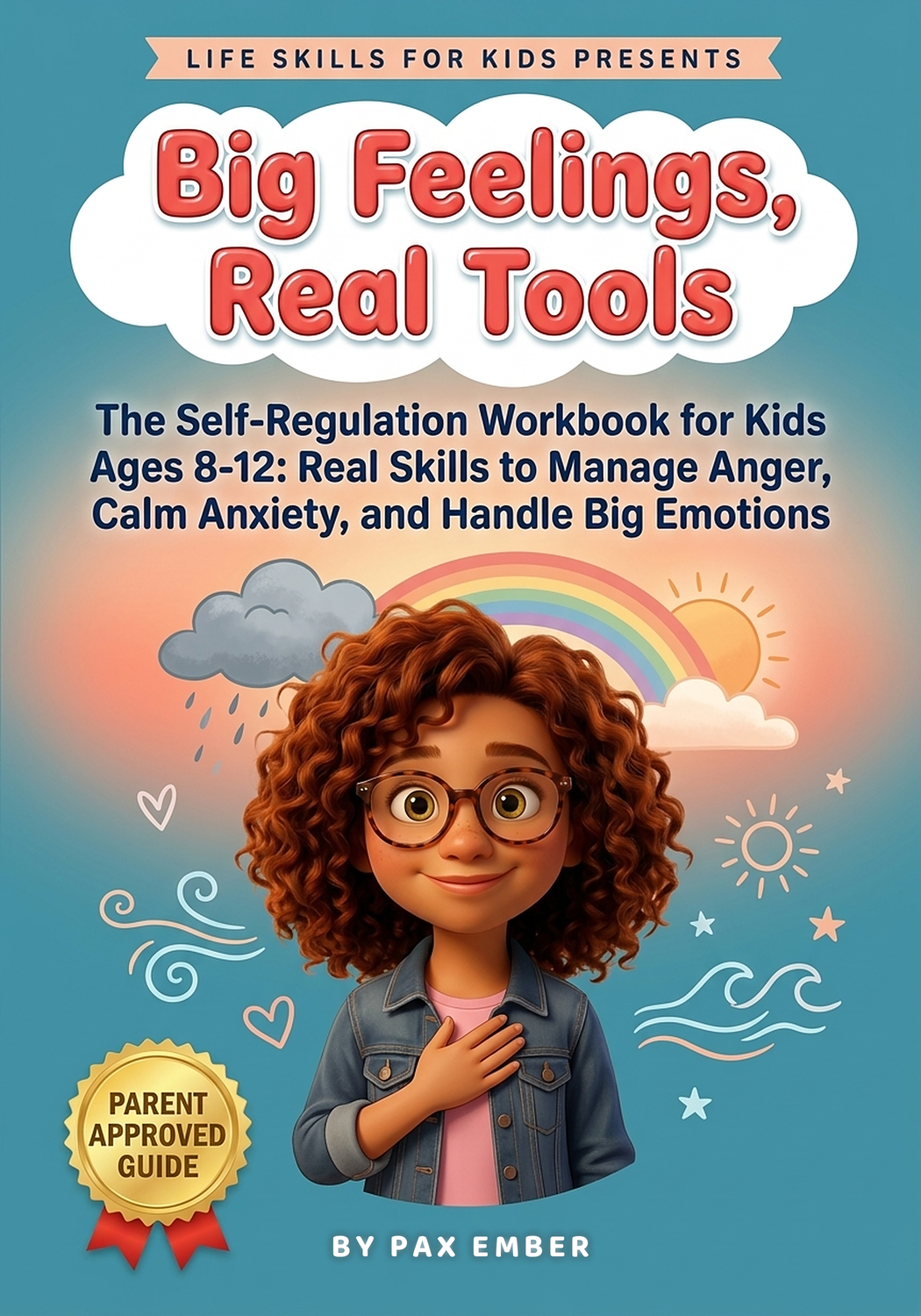
Big Feelings, Real Tools
The emotional skills workbook for kids ages 8 to 12, from the Life Skills for Kids series. Hands-On Missions kids complete themselves, Parent Corner guides for you, and tools that get built before the storm. Also on Amazon.
See the Book