How to teach kids about AI starts with a question, not a course
When parents search "how to teach kids about AI," most of the results are coding classes. That answers a different question. A kid does not need to build AI to understand it, any more than they need to build a car to cross a street safely. What a kid needs is to know what AI is, how it learns, where it goes wrong, and how to stay the one in charge of it. All of that can be taught at the kitchen table in a few weeks, with the apps already in the house.
Here is the order that works, the same order the book AI for Kids Ages 8 to 12 uses, because it is the order a kid's own questions come in.
1. Find the AI that is already in their life
Start with a hunt, not a lecture. Over one evening, list every place a kid already meets AI: the video feed that picks what plays next, the search bar that finishes their sentence, the photo app that finds faces, the game that gets harder when they get better. The point is not the list. It is the moment a kid realizes that AI is not a robot in a movie; it is something that has been making small decisions for them all day.
Ask one question at the end: "What does it know about you to do that?" Let them sit with it.
2. Show how it learns, with something they can touch
Explain AI the way it actually works: it learns from examples, finds patterns, and makes guesses. Then prove it. Sort a pile of objects together into two groups without saying the rule out loud, and have your kid guess the rule from the examples. That is a model being trained. Then add an object that does not fit and watch the rule break. That is the part most adults never learn, and a nine-year-old gets it in five minutes.
When a kid has felt a pattern break, "the AI got it wrong" stops being a surprise and becomes something to expect and check for.
3. Name what only a person can do
This is the chapter most AI books for kids skip, and it is the one that matters most. An AI can produce a thousand drawings; it cannot decide which one is good. It can write a paragraph; it cannot know whether the paragraph is true, or whether it is what you meant. Judgment, taste, curiosity, caring whether something is right: those are the kid's job, and saying so out loud changes how they use every tool after.
4. Let them direct it, then check it
Now, with you beside them, let your kid give an AI a real job: describe a picture to make, ask for a story with three specific things in it, ask a question you both already know the answer to. Then do the two things that make the habit: look at what came back together, and say what is wrong with it. Make it better by giving a clearer instruction. Repeat.
That loop, direct, check, improve, is the whole skill. A kid who learns it at nine will use AI as a partner for the rest of their life instead of handing their thinking to it.
5. Set the family rules together
Rules that a kid helped write get kept. Three are enough to start: nothing private goes into an AI, anything that matters gets checked against a real source, and when something feels off, you come get a grown-up. The safety side gets its own treatment in the second book, AI Safety for Kids and Teens, for ages 10 to 14.
What to use
Nothing on this page needs a paid tool. The free AI Toolkit for Kids lists safe, vetted tools for art, stories, and research, sorted by what a kid wants to make. Use the parent's account, stay in the room, and let the kid drive.
Questions parents ask
What age should kids start learning about AI?
Around eight, when they can read on their own and are already meeting AI in apps and games. The ideas on this page are written for ages 8 to 12.
Do kids need to learn coding to understand AI?
No. Coding is one way to build AI; understanding it is a different skill. A kid who knows how AI learns, where it fails, and how to direct and check it has the skill that matters, with or without code.
Is it safe to let my kid use AI tools?
With a parent beside them, using the parent's account, and with the family rules set first. The free AI Toolkit for Kids lists tools that are built for that.
How long does this take?
A few weeks of short sessions. One idea per evening, with something to try each time, beats a weekend course.
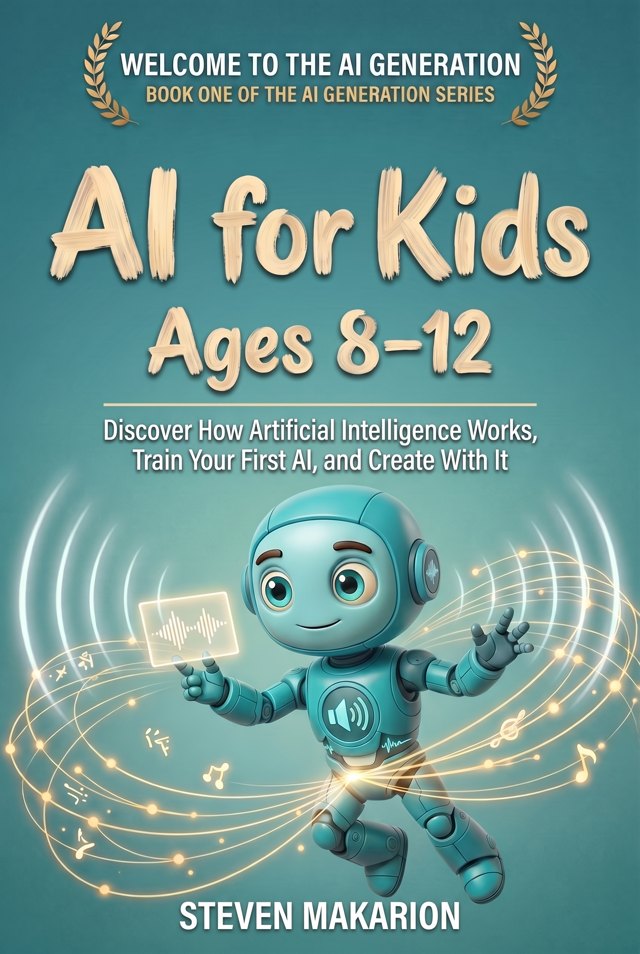
AI for Kids Ages 8 to 12
The first book of the AI Generation series, by Steven Makarion. How AI works, how to train a first one, and how to create with it, with a Hands-On Mission in every chapter. Also on Amazon.
See the Book