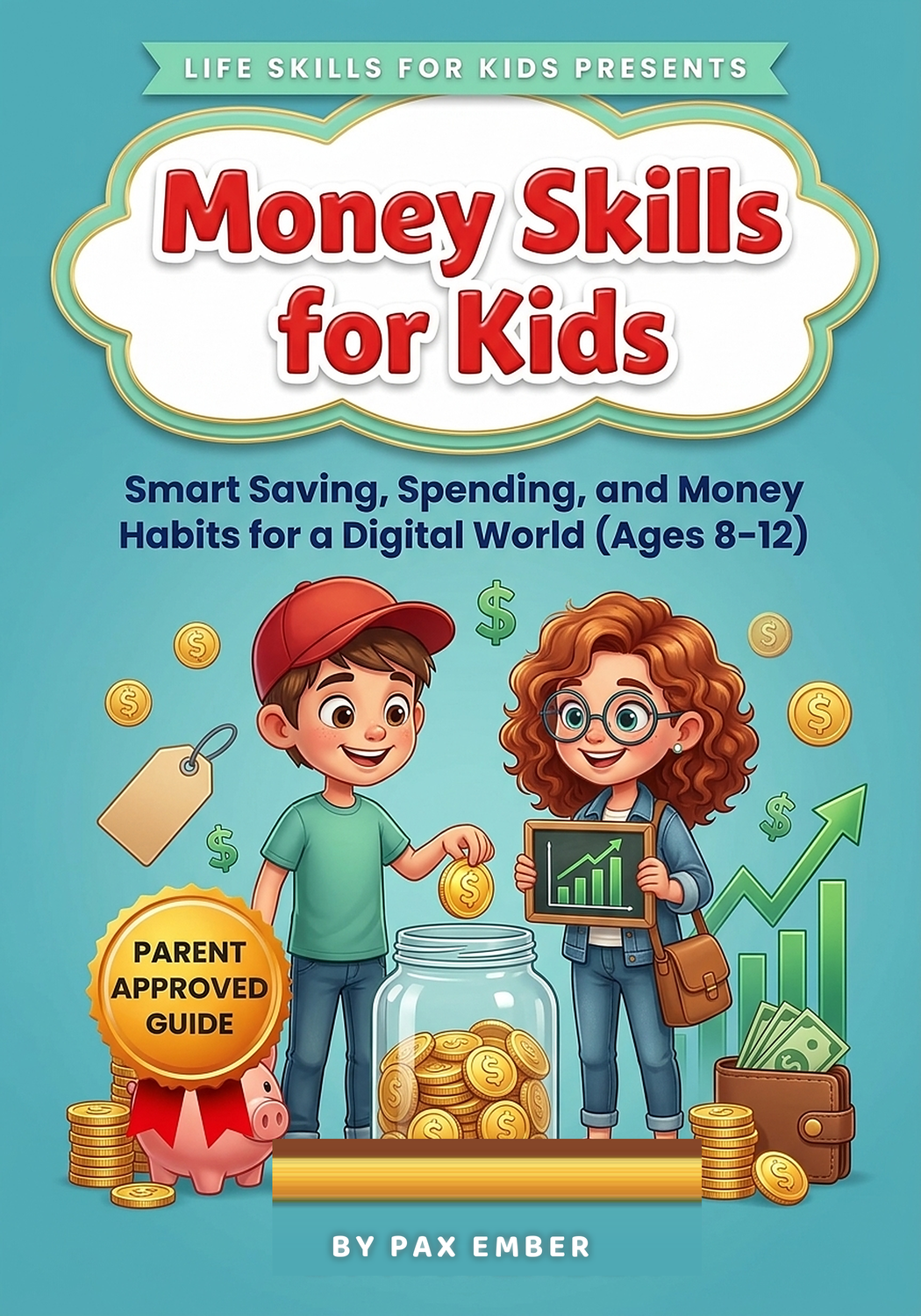
Money Skills for Kids
How money works, and how to earn, save, spend, and give it with a clear head. A hands-on workbook for kids ages 8 to 12.
Real money, real jobs, real jars. The habits that make a kid good with money start here, while a mistake still costs five dollars.
Get it on AmazonWhy teach kids about money at 8, not 18?
Most adults learned money the expensive way: first credit card, first overdraft, first "where did my paycheck go." The habits underneath those moments were already set by then, and nobody had ever handed us a practice field.
Ages 8 to 12 are the practice field. A kid this age can earn real money, want something badly enough to save for it, and feel the sting of spending the whole birthday twenty in one afternoon. Every one of those moments is a cheap rep for a skill that gets very expensive to learn later.
Money Skills for Kids turns those moments into a plan: not a lecture about compound interest, but jars on the dresser, a goal taped to the wall, and a kid who knows why the jars are there.
Allowance for kids, without the family fight
Allowance is where most families start, and where most of the arguments live. Should it be tied to chores? How much by age? What happens when it's gone by Tuesday?
The book doesn't preach one system. It lays out the three common approaches, chores-based, hybrid, and no-strings, and helps your family pick one on purpose. Then it hands your kid the part that matters more than where the money comes from: what to do with it. Every dollar that comes in gets split across three jars: save, spend, and give, in a ratio your kid sets and defends.
When the spend jar runs dry before the thing they wanted, that's not a failure. That's the lesson working, at a price you'll happily pay.
What's inside
- Where money comes from: work, value, and why anyone pays anyone
- Earning: first jobs, chores worth charging for, and the neighbor-kid businesses that actually work
- Saving: picking a goal, making it visible, and the trick to not raiding the jar
- Spending: smart trade-offs, and how ads are built to work on your brain
- Giving: choosing something you care about and giving on purpose, not on guilt
- Banks and interest: the beginner version of where money sleeps and how it grows
Every chapter follows the series rhythm: the skill, the steps, a Hands-On Mission with success criteria, and a Parent Corner for you.
Questions parents ask
What age should I teach my kids about money?
Earlier than most of us were taught. By 8, kids can handle earning, saving, and small spending decisions with real money. This book is built for the 8 to 12 window, when habits form and mistakes are still cheap.
How much allowance should a kid get?
The book gives you the honest answer: the amount matters less than the system. It helps your family pick an approach on purpose and helps your kid manage whatever the number is.
Do we need real money for the missions?
Small real amounts work best, because feeling a real trade-off is the point. A few missions run fine on a paper ledger while your kid earns their first dollars.
Do I need to be good with money to help?
No. The Parent Corner gives you the short version of each idea and one dinner-table question. Your kid runs the missions; you stay in the conversation.
Part of the Life Skills for Kids series
Money Skills for Kids sits alongside the age-by-age Life Skills books, Social Skills for Boys, AI Skills for Kids, and Big Feelings, Real Tools. Same rhythm in every book: real skills, hands-on missions, and a Parent Corner that keeps you in the loop without putting you in charge.
Want the free companion? The Money Toolkit has printable jars, goal trackers, and the first mission free.
Get the free Money Toolkit
Printable save-spend-give jars, a goal tracker, and the first Hands-On Mission, free.